German Roach & Rat Treatment in Florida: A Pet-Safe FAQ for Homeowners
You have roaches behind the stove and rats getting into the dog food. This guide explains how German roach treatment actually works, how bait stations control rats, and how professionals keep products away from pets. It also shows what shapes your price so you can request accurate quotes.
Calls may be recorded for quality and matching purposes.
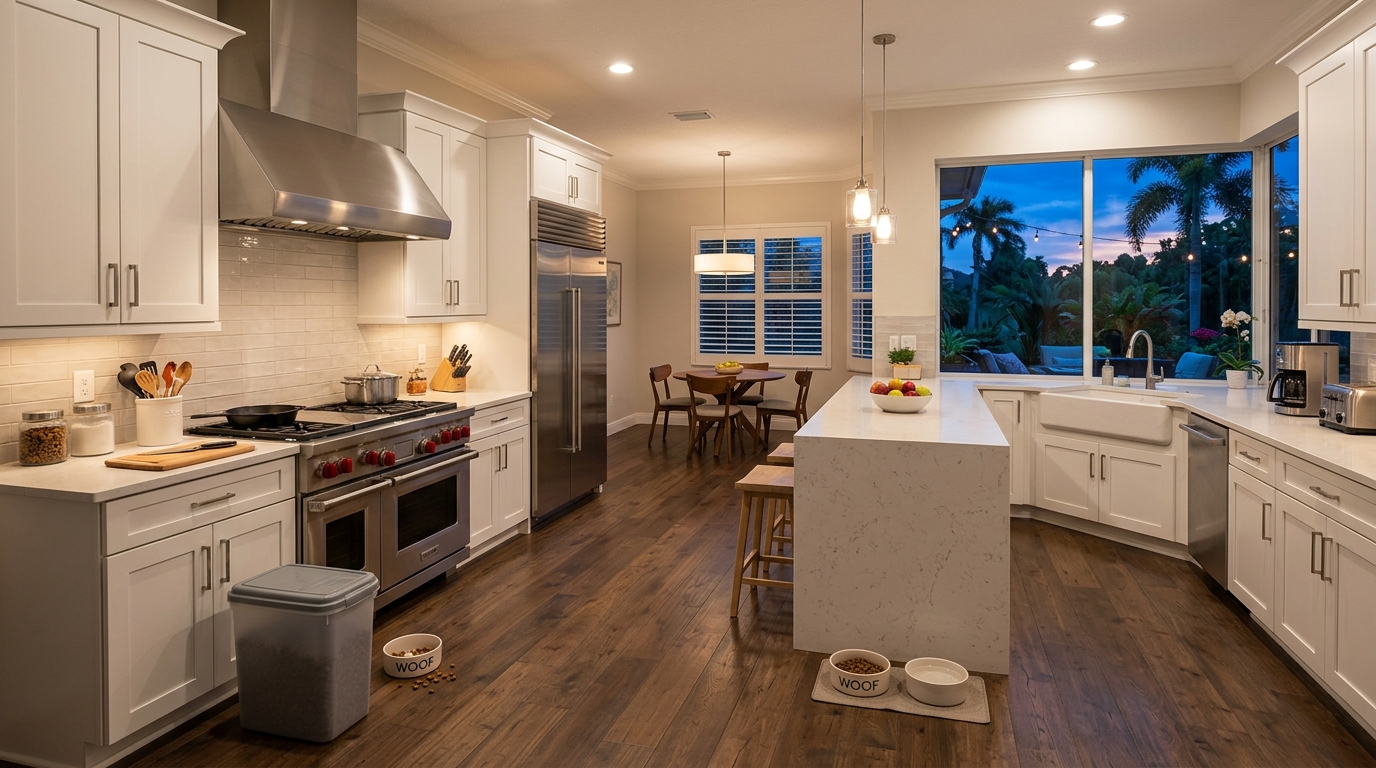
Who this guide is for and what you are trying to decide
This page is written for the Florida homeowner facing two problems at once: German cockroaches in the kitchen and rats feeding on pet food. If you see roaches scatter when you open a cabinet at night, and you find droppings near the stove or the dog bowl, you are the reader we wrote this for.
You are trying to decide three things: what a treatment plan really involves, roughly what it costs, and whether the products are safe around your dog or cat. Those are exactly the gaps most homeowners cannot answer before they call for a quote.
Why roaches and rats often show up together
Both pests want the same things: warmth, moisture, and easy calories. A bag of dog food left open overnight feeds roaches and rats alike. Warm motor housings—behind the refrigerator, under the stove, inside the dishwasher frame—give German roaches the 70–85°F range they breed fastest in.
HomePest Match is an independent guide. We do not treat homes and we do not sell products. We explain how treatment works and connect you with licensed Florida providers when you are ready. You always start the contact; providers do not cold-call you.
What to expect from this FAQ
- The German roach lifecycle and why it drives urgency
- How rodent bait stations work and why placement matters
- Pet-safe measures professionals use
- The questions that get you an accurate quote
- What actually shapes your price in Florida
By the end, you should be able to describe your problem clearly and read a quote without guessing. That is the fastest path to a treatment plan that fits your home and your pets.
What homeowners misunderstand: the German roach lifecycle drives everything
The biggest misunderstanding is treating German roaches like a spray-and-done job. They are not. The reason is biology, and understanding it changes how you judge every quote you receive.
How the lifecycle works
A German cockroach (Blattella germanica) develops through three stages: egg case, nymph, and adult. The egg case is called an ootheca—a small brown capsule the female carries until the eggs are nearly ready to hatch. According to university extension entomology sources, a single ootheca holds roughly 30–40 eggs. One female can produce several egg cases across her life, so a small population becomes a large one fast.
Here is the part that trips people up: nymphs mature into breeding adults in about seven to twelve weeks under warm indoor conditions. Florida kitchens stay warm year-round, so there is no winter pause. Breeding continues in January the same as in July.
Why one spray never finishes the job
Insecticide contact sprays kill roaches that are out walking. They do not reliably kill eggs sealed inside an ootheca. When those eggs hatch days later, you see roaches again and assume the treatment failed. It did not fail—it simply did not cover the next generation.
This is why professionals rely on gel baits and insect growth regulators (IGRs). Gel bait is eaten, carried back to harborage, and passed to other roaches through droppings and cannibalism. An IGR is a chemical that prevents nymphs from maturing, breaking the breeding cycle. Together they attack the population over multiple weeks, not one visit.
What this means for your expectations
- Real German roach control usually takes several visits over 4–8 weeks.
- Fast, visible drops followed by a rebound are normal mid-treatment.
- A quote promising one-visit elimination should make you cautious.
For more on this pest in the state, see the cockroach control in Florida overview.
Signs you are dealing with German roaches and rats—not something else
Correct identification changes the treatment. German roaches and rats each leave distinct evidence, and telling them apart from other pests saves you money on the wrong service.
German roach signs
- Size and color: adults are small, about half an inch, light brown, with two dark parallel stripes behind the head. This distinguishes them from the large reddish-brown American cockroach (the "palmetto bug") common outdoors in Florida.
- Where they hide: tight, warm cracks near food and water—stove seams, dishwasher gaskets, under the sink, behind the fridge motor.
- Droppings: tiny black specks resembling ground pepper along cabinet edges.
- Egg cases: small brown capsules in corners of drawers.
- Daytime sightings: seeing roaches in daylight often signals a heavy population, because harborage is overcrowded.
Rat signs
- Droppings: dark, capsule-shaped, larger than roach specks, often near the pet-food storage area.
- Gnaw marks: chewed bag corners, chewed baseboards, or a chewed dog-food container lid.
- Grease rubs: dark smudges along walls where rats travel the same routes.
- Sounds: scratching in walls or the attic at night.
In Florida, the roof rat is common statewide and climbs well, entering through soffits, roof gaps, and utility line penetrations. Norway rats stay lower, favoring garages and crawl spaces.
The pet-food connection
When rats eat from the dog bowl and roaches gather behind the stove, you have a shared food-and-shelter problem. Storing pet food in a hard, sealed container and cleaning up crumbs immediately removes the single strongest attractant. That step alone improves how well any professional treatment works. For the broader picture, see the rodent control in Florida guide.
What actually works—and when DIY stops being enough
Some early steps you can do yourself. Beyond a point, the biology outruns store products. Knowing where that line falls prevents wasted money.
German roach treatment that works
- Gel bait placement: small dabs in cracks and hinges where roaches hide, not out in the open. Bait works because roaches share it through their colony.
- Insect growth regulator: a professional adds an IGR to stop nymphs maturing, collapsing the breeding cycle.
- Sanitation and exclusion: fix leaks, seal gaps, and remove food residue so bait becomes the most attractive food source.
- Follow-up visits: a second and third service catch newly hatched nymphs.
Rat control that works
- Exclusion first: sealing entry points with rodent-proof materials matters more than any bait. Rats reproduce fast, so blocking access is the durable fix.
- Tamper-resistant bait stations: locked black boxes that hold bait or snap mechanisms inside a housing pets and children cannot open.
- Snap traps in enclosed areas: effective in attics and wall voids where pets cannot reach.
- Monitoring: stations are checked and re-baited on return visits.
When DIY fails and why
DIY fails most often for three reasons. First, over-the-counter sprays scatter roaches into new harborage, spreading the infestation. Second, they miss the ootheca, so hatchlings restart the population. Third, loose rodent bait or unhoused snap traps create real pet hazards without solving the entry-point problem.
If you still see roaches after two weeks of careful baiting, or rats keep returning after you set traps, the population has outgrown DIY. That is the point to request professional quotes. To understand how a provider builds a plan, read how treatment plans and guarantees work in Florida.
How professionals keep treatment pet-safe
Pet safety is the question homeowners ask most and the one product labels answer most precisely. In the United States, pesticide labels are legally enforceable directions approved through the EPA registration process, and licensed technicians must follow them. That legal framework is the backbone of pet-safe application.
Placement is the main safety control
The core principle is simple: put the product where the pest travels and the pet cannot reach. For German roaches, gel bait goes inside cracks, hinges, and voids—never smeared on open floors or counters your dog can lick. For rats, bait sits inside tamper-resistant stations anchored so a pet cannot move or open them.
Questions to ask about pet safety
- Which products will you use, and are they labeled for homes with pets?
- How long should pets stay off treated surfaces after application?
- Will rodent bait be in locked, anchored stations only?
- Do you offer non-bait rodent options like enclosed snap traps for pet-heavy homes?
Simple steps you can take on treatment day
- Move food bowls, water dishes, and bedding away from treatment zones.
- Keep dogs and cats in another room until surfaces are dry.
- Store pet food in sealed hard containers—this protects pets and starves pests.
A reputable Florida provider will explain re-entry timing and give you the product names to review. If a company cannot answer these questions clearly, treat that as a warning sign. For help comparing companies, see how to choose a pest-control company in Florida.
What to ask when you request quotes
Callers often start with "I'd like a quote for a roach and rat problem." The clearer your description, the more accurate the estimate—and the fewer surprises on the invoice.
Describe the problem precisely
- Name both pests: German roaches and rats.
- Say where you see them: "behind the stove" and "eating the dog food."
- Estimate how long it has been happening and how often you see activity.
- Mention pets in the home and any children.
Questions that shape a good quote
- Is this a one-time treatment or a multi-visit plan for roaches?
- How many follow-up visits are included, and over what timeline?
- Does rodent service include exclusion (sealing entry points) or only bait?
- Is there a guarantee, and what triggers a free re-service between visits?
- What pet-safe products and placements will you use?
A note on how contact works
When you call a provider, the line may state that the call can be recorded for quality assurance—that is standard. You control the conversation and you initiate it. HomePest Match does not treat homes; we match you with licensed Florida providers after you request quotes. You can start that at request Florida pest-control quotes.
Bring the details above to every call. Two providers quoting the same home should be quoting the same scope, so you can compare fairly. If one includes exclusion and follow-ups and another quotes a single spray, the low number is not the better deal—it is a different, smaller job.
What shapes your price in Florida (no guessing on numbers)
We do not publish fixed prices, because honest quotes depend on your home. Instead, here are the concrete factors that move the number up or down, so you can read any estimate with a clear eye.
Cost factors for German roach service
- Severity: a heavy, established population needs more visits and more bait than an early problem.
- Number of follow-ups: a proper plan usually spans several visits over 4–8 weeks.
- Home size and kitchen complexity: more cabinets, appliances, and voids mean more inspection and bait placement.
- Recurring vs. one-time: quarterly or monthly plans spread cost and maintain protection.
Cost factors for rat service
- Exclusion work: sealing entry points is labor-intensive and is the biggest variable. Sealing a roof-rat entry in a soffit costs more than dropping a few stations.
- Number of stations and trips: larger homes and heavier activity need more units and more monitoring visits.
- Access difficulty: attic and crawl-space work adds labor.
How to think about it
Statewide pricing context lives in the Florida pest control cost planning guide. Broadly, expect an initial service to cost more than each recurring visit, because the first visit includes inspection, heavy baiting, and setup. Recurring visits maintain the result.
One more practical point: sanitation and pet-food storage directly lower your effective cost. When you remove the food source, bait works faster and fewer follow-ups are needed. The homeowner who seals the dog food and fixes a leaky sink usually resolves the problem in fewer visits than the one who does not. Your habits are part of the treatment plan.
Common questions
How long does it take to get rid of German roaches?
Plan on several weeks, typically four to eight, with multiple visits. The reason is the lifecycle: egg cases hatch days after treatment, so a follow-up visit is needed to catch new nymphs. A single visit rarely finishes the job.
Are rodent bait stations safe around dogs and cats?
Tamper-resistant stations are designed to keep bait sealed inside a locked, anchored housing a pet cannot open. For pet-heavy homes, ask about enclosed snap traps as an alternative. Always move food bowls away from treatment areas and confirm re-entry timing with the technician.
Why do roaches come back after I spray them?
Over-the-counter sprays kill roaches that are out walking but usually miss eggs sealed inside the ootheca. When those hatch days later, activity returns and looks like failure. Gel baits plus an insect growth regulator work over weeks to break the breeding cycle.
Rats are eating my dog's food—what should I do first?
Store all pet food in a hard, sealed container and clean up spilled kibble immediately. Removing that food source is the single most effective first step. Then request professional quotes for exclusion and bait stations, since rats reproduce quickly and need entry points sealed.
How do I get an accurate quote for both roaches and rats?
Describe both pests, where you see them, how long it has been happening, and that you have pets. Ask whether roach service includes follow-up visits and whether rat service includes sealing entry points. Then compare quotes on matching scope, not just price.
Does one company treat both cockroaches and rodents?
Many Florida providers handle both, often on a recurring plan. Confirm that the quote covers roach follow-ups and rodent exclusion, not just a single spray or a few loose bait stations. You initiate contact and choose the plan that fits your home and pets.
Related: cockroach control in Florida · rodent control in Florida · how treatment plans and guarantees work in Florida · Florida pest control cost planning guide · request Florida pest-control quotes