Bee Removal: Who Handles It and How to Reach a Live Person Fast
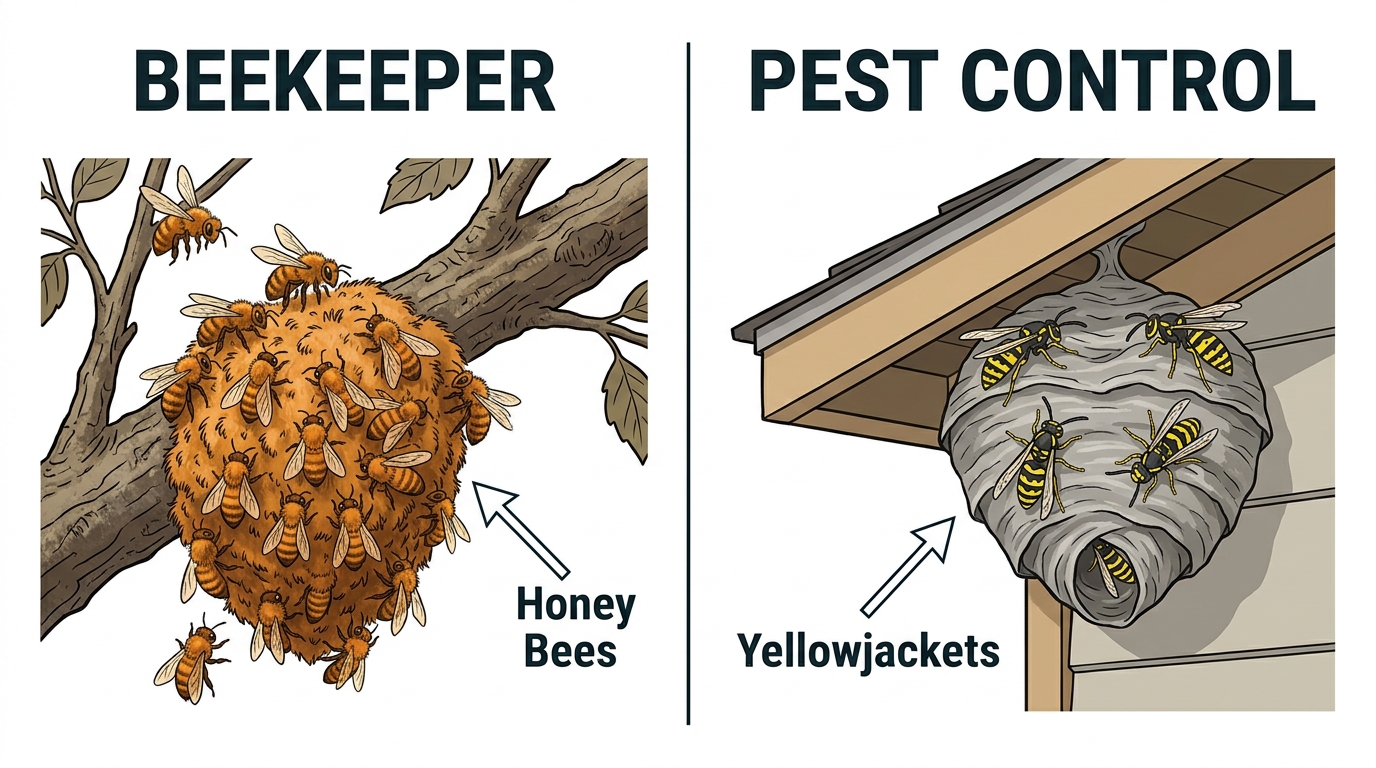
Honey bee swarms usually go to a beekeeper, not a pest company. Wasps, hornets, and yellowjackets go to pest control. Knowing which one to call first saves you a maze of automated menus and a dead-end voicemail.
Calls may be recorded for quality and matching purposes.
Who this is for and what you are trying to decide
This guide is for the homeowner who spotted bees and wants a live person on the line — not a phone tree. Maybe a cluster hangs from a tree branch. Maybe insects stream in and out of a soffit gap. You want to report it and book a visit today.
The first decision is not who to hire. It is what kind of insect you have. That single answer routes your call correctly and stops you from bouncing between the wrong departments.
Here is why this matters. Many large pest companies split their phone systems into two tracks:
- Wildlife or animal removal — usually raccoons, squirrels, bats, and sometimes honey bee colonies.
- General pest control — ants, roaches, spiders, and stinging insects like wasps and yellowjackets.
If you press the wrong option, you may land in a queue that cannot help you, then get dumped to voicemail. Callers report navigating three or four menus — wildlife versus pest, then a second prompt asking about bees, termites, or bedbugs — before reaching anyone.
So decide two things before you dial:
- Is it a honey bee or a wasp-type insect? This picks your provider type.
- Is the nest reachable or hidden inside a structure? This shapes the visit and the quote.
HomePest Match is an independent matching guide, not a pest company. We explain the routing so your first call is the right one. When you are ready to compare local options, our ZIP-code coverage checker shows who serves your address before you spend time on hold.
The part most homeowners get wrong: wildlife or pest control?
This is the gap that wastes the most time. Most people assume any company that removes creatures removes bees. That is not how the trade is organized, and the difference is biological.
Honey bees are usually a beekeeper's job
Honey bees (genus Apis) build wax comb and store honey. They are pollinators, and many pest companies will not exterminate them for that reason. Live honey bee swarms — a loose, hanging cluster with no comb yet — are often collected free or cheaply by local beekeepers or a beekeeper association, because a healthy swarm has value. An established colony inside a wall or chimney needs a cut-out: opening the structure, removing comb and bees, then sealing the cavity. That is specialized work.
Wasps, hornets, and yellowjackets are pest control
These are not bees. Yellowjackets and hornets (family Vespidae) build paper nests and can sting repeatedly. General pest control treats them, usually with a labeled insecticide and physical nest removal.
Where the phone menu confusion comes from
Big providers route honey bees to a specialty or wildlife line because eradication may be restricted or discouraged. They route wasps to standard pest control. So the correct menu choice depends on your identification.
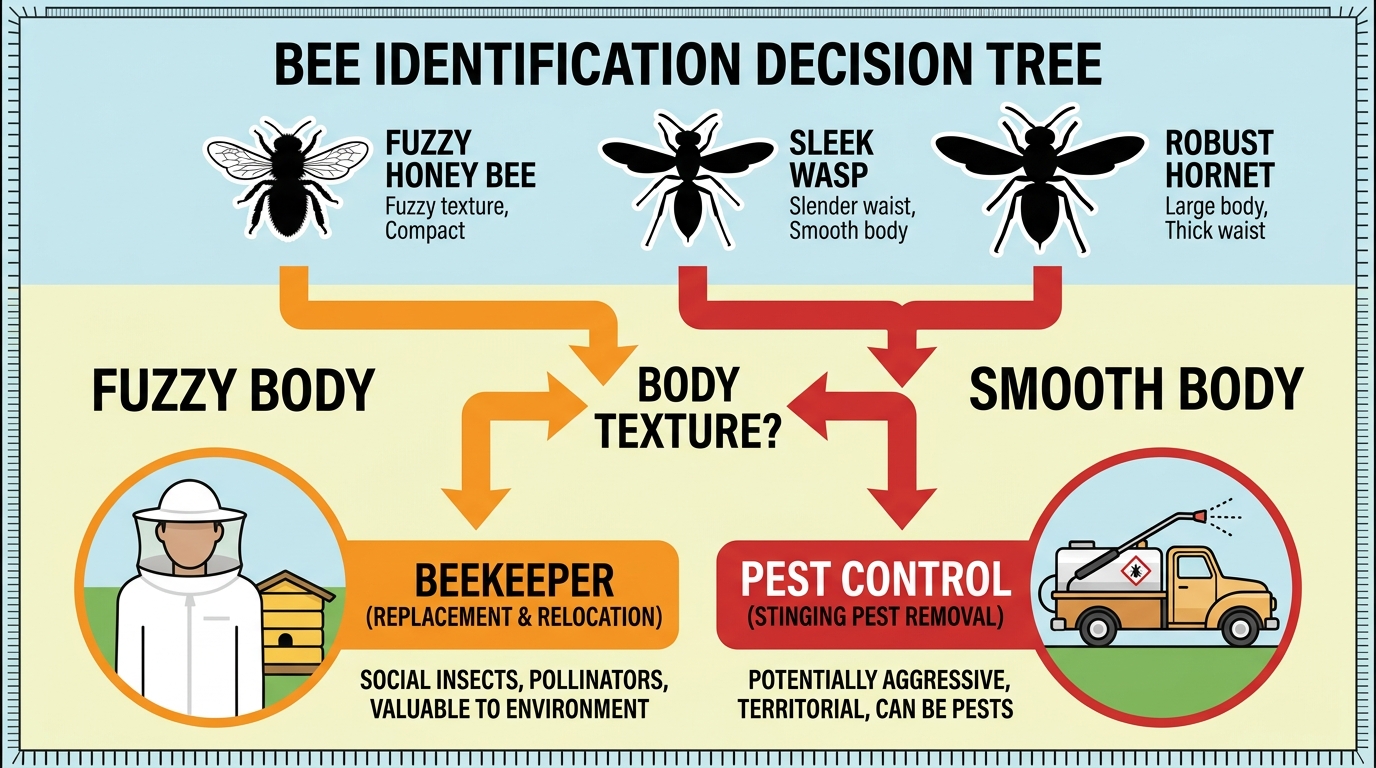
- Honey bee swarm or colony → ask for bee removal or beekeeper referral, not extermination.
- Wasp, hornet, or yellowjacket nest → choose general pest control.
- Not sure → say "stinging insect, need identification" and let the representative route you.
The U.S. Environmental Protection Agency notes that pollinator-safe practices favor relocation of honey bees over chemical control. Naming the right insect on your call unlocks the right answer faster.
How to tell what you actually have
You do not need to be an entomologist. A few visual and behavioral cues sort most cases in under a minute.
Honey bees
- Golden-brown to amber, fuzzy body, about half an inch long.
- Travel in dense, coordinated traffic in and out of one small opening.
- A swarm looks like a hanging beard of insects on a branch, fence, or eave — often calm and clustered.
- Inside a wall you may hear a steady hum and see wax or honey staining after weeks.
Bumble bees
- Large, round, very fuzzy, black and yellow.
- Nest low — in ground holes, mulch, or wall voids — in small numbers.
- Generally docile; often left alone unless the nest sits in a doorway or high-traffic path.
Wasps, hornets, yellowjackets
- Slender, smooth, shiny body with a narrow waist. Little to no fuzz.
- Paper wasps: open, umbrella-shaped nest under eaves.
- Hornets: large gray football-shaped enclosed nest in trees or shrubs.
- Yellowjackets: fast, aggressive; nest in the ground or wall voids with heavy traffic.
Fast field checks
Watch the entry point from a safe distance. Steady, purposeful traffic to one hole often means an established colony. Look for the nest shape: paper and gray means wasp family; wax comb means honey bee. Note the time of day — cooler morning hours mean lower activity and safer observation.
Never poke, spray, or seal an active entry while insects are inside. Sealing traps them and can push a colony deeper into living space. Photograph the insect and nest from several feet away. A clear photo lets a provider identify the species over the phone and quote accurately.
What actually works — and when DIY fails
Method depends entirely on species and nest location. Match the approach to the biology.
Live honey bee removal
For a hanging swarm, a beekeeper gently boxes the cluster and relocates it. This is often the cheapest and most eco-friendly outcome. For an established colony in a cavity, a cut-out is required: locating the comb (sometimes with a thermal camera), opening the wall or soffit, removing all comb and bees, and sealing the void. If comb and honey remain, it rots, attracts other pests, and stains drywall — so removal must be complete.
Wasp and hornet control
A pest technician applies a labeled insecticide directly to the nest, then removes it. Products used must be registered by the U.S. Environmental Protection Agency for that site and pest. Ground-nesting yellowjackets often need the entry hole treated at dusk when the colony is inside.
When DIY fails
- Height and hidden nests. Wall-void and roofline nests need access work and protective gear. Store sprays rarely reach the core.
- Aggressive species. Yellowjackets and hornets defend nests in numbers and can sting repeatedly. Disturbing them without gear risks serious stings.
- Allergy risk. If anyone in the home has a known sting allergy, do not attempt treatment. Call a professional.
- Honey bee cavities. Killing bees in a wall without removing comb is a classic mistake. Trapped honey ferments and draws ants, roaches, and moths.
Integrated Pest Management principles — identify first, use the least-toxic effective method, and prevent reentry by sealing gaps — apply here too. Relocation beats eradication whenever the insect is a pollinator.
How to reach a live person fast and book the visit
The maze is beatable. Use these tactics to skip past the automated prompts and get scheduled.
Prepare before you dial
- Your five-digit ZIP code — the first thing most systems ask.
- The insect type (honey bee, wasp, hornet, yellowjacket) or "stinging insect, needs ID."
- Nest location — eave, tree, ground, or inside a wall.
- Whether it is a home or business — a common menu branch.
Navigate the menus
Many bee and stinging-insect calls are routed under a specialty prompt alongside termites and bedbugs. Listen for that grouping. If prompted "wildlife" versus "pest control," choose based on your identification: honey bees may sit under wildlife or a bee-specific option; wasps sit under general pest control.
Get to a human
- Press 0 or say "representative" or "agent" — many systems accept this.
- Stay silent when a speech menu runs; some route unrecognized input to an operator.
- Call during business hours; after-hours lines often dead-end in voicemail.
Because a live representative is not always available on the first try, using an independent matching step first can save calls. Our guide on what to expect when you report a pest problem walks through the intake questions. If you initiate contact, note that provider lines are often recorded for quality assurance — a standard disclosure you will hear at the start.
What to ask on the call
- "Do you remove honey bees live, or only exterminate?"
- "Do you do wall cut-outs, or refer to a beekeeper?"
- "Are you licensed for structural pest control in my state?"
- "Do you seal the entry point after removal?"
What shapes the cost of bee and wasp removal
No two bee jobs price the same. These factors drive the estimate — ask about each so the quote makes sense.
Species and legal status
Live honey bee swarm collection is often the lowest-cost path and sometimes free through a beekeeper association. Wasp nest treatment is typically a straightforward service visit. A honey bee cut-out costs more because it involves construction access and cleanup.
Nest location and access
- Exposed nests (eave, low branch) are quickest and cheapest.
- Ground nests add digging or repeated treatment.
- In-wall or roofline colonies require opening the structure — the biggest cost driver.
- Height may require ladders, lifts, or a second technician.
Colony size and age
An established honey bee colony with heavy comb and stored honey takes longer to remove fully. A fresh swarm collects in minutes.
Repair and sealing
Removing comb from a wall leaves an opening. Ask whether the quote includes repair or just removal. Sealing the entry prevents a new colony from moving into the same cavity.
Follow-up and guarantees
Wasps sometimes rebuild nearby; ask about return visits. Some providers guarantee that a treated area stays clear for a set period.
Because ranges vary widely by region and access, get itemized quotes and compare on scope, not just the headline number. Our coverage-by-ZIP tool helps you find providers that actually serve your address before you ask for a price. HomePest Match does not perform removals; we help you reach the right provider and ask the right questions.
Common questions
Does wildlife removal or pest control handle bees?
It depends on the insect. Honey bees usually go to a beekeeper or a specialty bee-removal line, since many companies relocate rather than kill pollinators. Wasps, hornets, and yellowjackets go to general pest control. If a phone menu splits wildlife from pest control, choose based on that identification.
How do I reach a live person and skip the automated menu?
Have your ZIP code and insect type ready, then press 0 or say "representative" or "agent." Call during business hours, since after-hours lines often route to voicemail. Staying silent through a speech menu sometimes connects you to an operator.
Will a pest control company kill honey bees?
Many will not, because honey bees are important pollinators. They often refer you to a beekeeper for live removal instead. If a colony is inside a wall, ask specifically whether they perform live cut-outs or only refer out.
What if no provider covers my rural address?
Check a ZIP-code coverage tool first so you only call companies that serve you. For live honey bee swarms, a regional beekeeper association is often willing to travel to rural areas because a healthy swarm has value to them.
How do I verify a company handles my exact stinging insect?
Describe the insect and nest shape on the call, or send a photo. Ask directly: "Do you treat wasps and hornets, remove live honey bees, and seal the entry afterward?" Confirm they hold the required state structural pest-control license before booking.
Is it safe to seal the entry hole myself?
No. Sealing an active entry traps insects inside and can push a honey bee colony deeper into living space, where trapped comb and honey rot and attract other pests. Let a provider remove the colony first, then seal the void.
Related: check pest control coverage by ZIP code · what to expect when you report a pest problem · how to report a pest problem