Cockroach and Mouse Infestation in a Single-Family Home: What Actually Works
A single-family home with both cockroaches and mice needs two different control strategies running at once. Before you sign up with any company, confirm one thing first: whether that provider actually services your ZIP code. Many national brands do not cover every address, and you find out only after you call.
Calls may be recorded for quality and matching purposes.
Who this guide is for and the decision you face
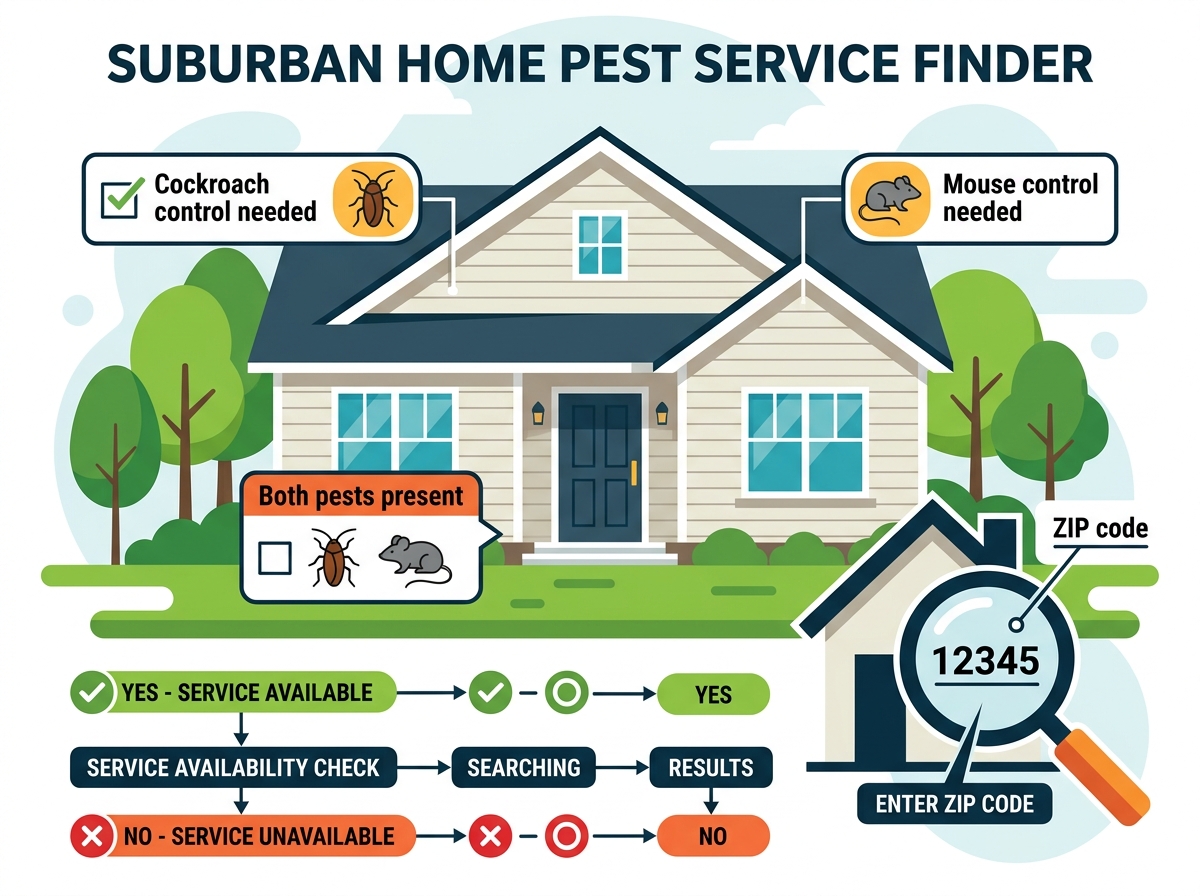
You have roaches in the kitchen and signs of mice somewhere in the walls. You want one company to handle both, and you want service to start soon. That is a reasonable goal, but it hides a decision most homeowners skip.
The first question is not price. It is coverage. When you call a national brand, the very first thing they ask is your ZIP code, because that determines whether a local branch or contractor serves your address at all. Callers routinely reach a company, describe the pests, then hear that their area is "not serviceable." That wastes time you do not have when an infestation is growing.
So the real decision is a sequence:
- Confirm coverage first. Does a qualified provider actually service your ZIP code and your property type?
- Confirm pest fit. Does that provider treat both German cockroaches and house mice, not just one?
- Then compare the offer. Plan structure, first-visit scope, and follow-up cadence.
HomePest Match is an independent matching guide, not a pest-control company. We do not send technicians and we do not treat homes. This page exists to help you understand the problem and ask sharper questions before you contact any provider. You always initiate the call.
The rest of this guide follows a five-question spine: what people misunderstand, how to recognize each infestation, what actually works, what to ask for a quote, and what drives cost. Read the coverage section next, because it closes the gap that trips up the most callers.
The gap most homeowners miss: coverage by ZIP code
Here is what surprises people. A well-known national brand advertising in your city does not automatically service your street. Pest-control companies operate through branch territories and, in some regions, through independent contractors or franchises. Each branch has a defined service radius. Your ZIP code may sit just outside it.
That is why the recorded intake call always opens the same way. The agent asks your name, whether you are a new or existing customer, what pest you have, and then "Can you please provide a ZIP code?" The ZIP check happens before any quote because coverage is the gate. If your area is not serviceable, the conversation ends there, or you get transferred elsewhere.
Why coverage gaps happen
- Distance and drive time. Branches limit territory so technicians can reach recurring stops efficiently. Rural and edge-of-metro addresses often fall outside.
- Licensing by location. Pest-control operators must hold a state license, and some companies staff only certain regions. Verify a company's license through your state structural pest-control regulatory agency before you commit.
- Franchise boundaries. With a franchise brand, the local owner sets the covered ZIP codes, which may differ from the national map.
How to check before you call
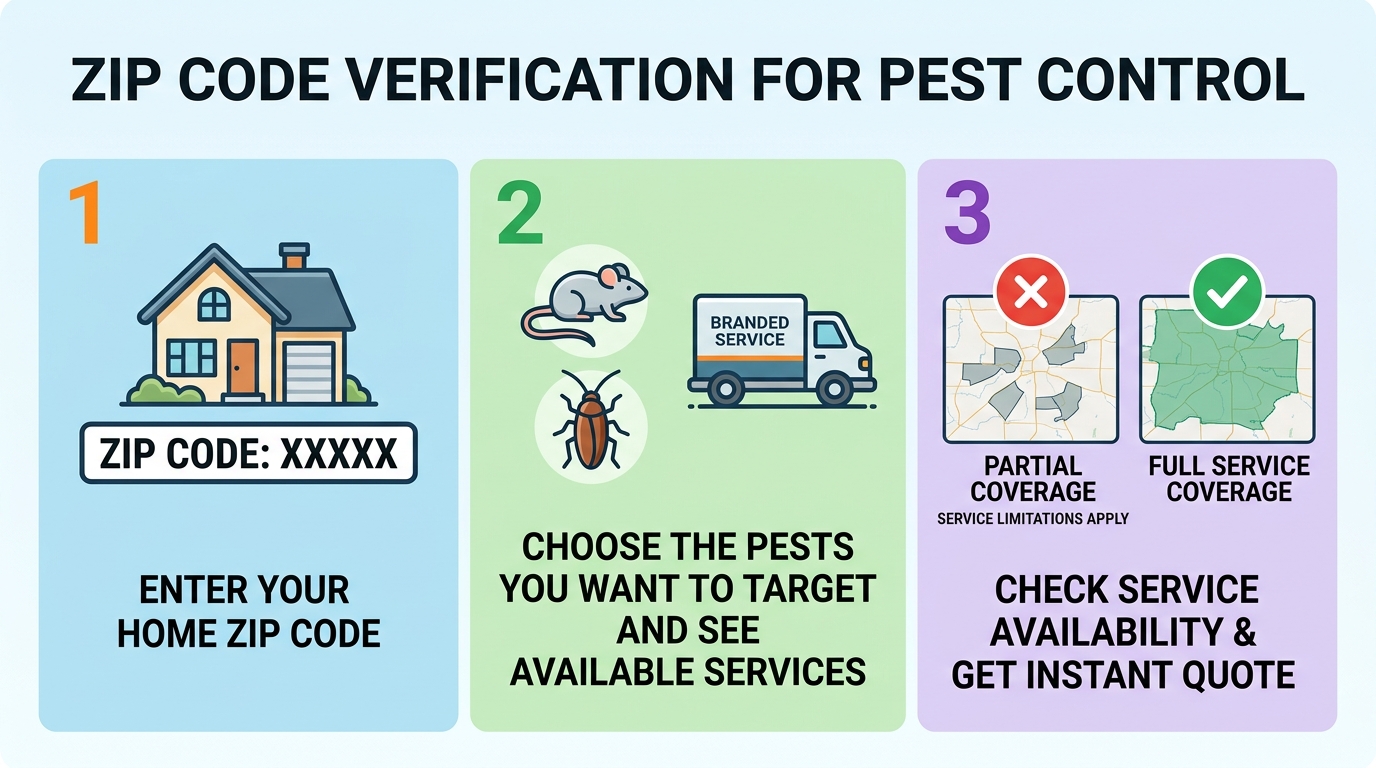
Use a simple three-step filter: ZIP check → pest fit → quote request.
- ZIP check: Confirm a provider services your exact ZIP and a single-family residence, not only commercial accounts.
- Pest fit: Confirm they treat both cockroaches and rodents on the same plan or the same visit.
- Quote request: Only then describe your home and ask for pricing.
Our companion page, how to check pest-control service area coverage by ZIP code, walks through this filter in detail. Running it first saves you from repeated dead-end calls.
Recognizing the two problems: cockroaches and mice
Cockroaches and mice leave different evidence. Reading it correctly tells a provider what you are dealing with and how large the population may be.
German cockroach signs
The German cockroach (Blattella germanica) is the species that infests kitchens and bathrooms. Adults are light tan with two dark stripes behind the head, about half an inch long. Look for:
- Live roaches at night near the stove, under the sink, and behind the refrigerator, where warmth and moisture collect.
- Fecal spotting: tiny black specks like ground pepper along cabinet edges and hinges.
- Oothecae: the egg case, a tan capsule holding 30 to 40 eggs, often glued inside a cabinet hinge or crevice. Finding these means the population is reproducing on site.
A single female and her offspring can produce hundreds of roaches within months, which is why early sightings escalate fast.
House mouse signs
The house mouse (Mus musculus) is small and can enter through a gap the width of a pencil, roughly a quarter inch. Look for:
- Droppings: dark, rod-shaped, about a quarter inch, concentrated along walls and inside cabinets.
- Gnaw marks on food packaging, baseboards, and wiring.
- Rub marks: greasy smudges along travel paths where fur touches walls.
- Nighttime scratching in walls or ceilings.
Mice follow the same walls repeatedly, so their evidence clusters along edges. Roaches cluster near heat and water. Mapping both patterns helps a technician place bait and traps where the animals actually travel, not randomly.
What actually works, and when DIY fails
Cockroaches and mice need separate methods because their biology differs. Trying one product for both fails.
Cockroach control: gel bait and growth regulators
The professional standard for German cockroaches is Integrated Pest Management (IPM) — a strategy from university extension programs that combines sanitation, exclusion, and targeted low-toxicity products instead of broad spraying. Read the UC IPM cockroach fact sheet for the mechanism.
The core tool is gel bait, placed as small dots along cabinet edges, hinges, and cracks. Roaches eat it, return to the harborage, and die there; other roaches feed on the carcass and feces, spreading the active ingredient. This is why bait outperforms spray, which scatters roaches and misses hidden populations.
Professionals add an insect growth regulator (IGR) — a compound that disrupts the roach life cycle rather than killing on contact. Hydroprene, sold under the trade name Gentrol, mimics juvenile hormone so nymphs never reach breeding maturity. These are EPA-registered products, and technicians follow label rates.
Why DIY roach control stalls
- Bait aversion: some German cockroach strains avoid certain bait sweeteners, so a single store product may stop working.
- Wrong placement: spraying visible surfaces drives roaches deeper without touching the harborage.
- No IGR: killing adults without breaking the breeding cycle lets the population rebound.
Rodent control: exclusion plus trapping
Mice are controlled by exclusion — sealing entry points with steel wool and hardware cloth — combined with snap traps and, where labeled, tamper-resistant bait stations. Trapping alone fails if the gaps stay open, because new mice keep entering. Sanitation removes the food that sustains both pests. DIY often fails because homeowners seal the obvious holes but miss utility penetrations and the gap under exterior doors.
What to ask when you request quotes
When you call a provider, expect the intake script: your name, new-or-existing status, the pest, and your ZIP code. Have those ready. Then turn the conversation toward the details that decide whether the plan fits a dual infestation.
Coverage and fit questions
- "Do you service my ZIP code and single-family homes?" Confirm this first, before anything else.
- "Does one plan cover both cockroaches and mice, or are they billed separately?"
- "Are you licensed in my state, and can I verify your license number?"
Treatment scope questions
- "What does the first visit include for each pest?" A thorough roach visit uses gel bait and an IGR, not just a perimeter spray.
- "Will you inspect and seal rodent entry points, or only set traps?" Exclusion matters more than bait for lasting control.
- "How many follow-up visits are included, and how far apart?" German cockroach knockdown usually needs a re-service two to four weeks after the first, timed to catch newly hatched nymphs.
Plan and terms questions
- "Is this monthly, quarterly, or a one-time treatment?" Heavy roach infestations often need tighter intervals at the start.
- "What happens if pests persist between scheduled visits?" Ask how re-treatment requests work; you initiate them.
- "Are calls recorded?" Many intake lines disclose recording for quality assurance.
Our guides on pest-control service plans and pricing and what to expect when you report a pest problem show how these answers shape the offer. Compare at least two providers who both clear the ZIP-code check.
What shapes the cost of dual roach and rodent control
No honest guide quotes a firm price sight unseen, because several factors move the number. Here are the concrete drivers a technician weighs, so you can anticipate them.
Infestation severity
A kitchen with scattered roach sightings is far cheaper to control than one with oothecae in multiple cabinets and heavy fecal spotting. Severity often decides how many early visits you need. The more re-services in the first month, the higher the near-term cost.
Two pests, two protocols
Because cockroaches and mice require different products and labor, treating both costs more than one alone. Rodent exclusion is labor-intensive; sealing entry points with hardware cloth takes time and adds materials. Bait and IGR for roaches add product cost.
Home size and construction
- Square footage and stories raise the treatable area and inspection time.
- Crawl spaces and unfinished basements create extra rodent harborage that must be inspected and sealed.
- Older homes with more cracks and utility penetrations take longer to exclude.
Plan structure
A one-time treatment costs less upfront but rarely resolves a reproducing German cockroach population. Recurring plans spread visits over months and usually include re-service between scheduled stops. For a heavy start-up situation, an initial intensive phase followed by maintenance is common.
Ask each provider to itemize the initial visit versus recurring cost, and whether follow-ups are included or billed. For a deeper breakdown of plan intervals, see our service plans and pricing guide. Treat any figure you find online as a published range, not a promise; only an on-site inspection produces a real quote.
Common questions
How do I know if a company services my ZIP code?
Ask for a coverage check before anything else, since branches and franchises limit their territory. The intake agent will request your ZIP code first because it decides whether service is even available. If your address falls outside the branch radius, you will hear it is not serviceable.
Can one provider treat both cockroaches and mice?
Many can, but the two pests need different methods, so confirm both are covered. Roaches call for gel bait and a growth regulator; mice call for exclusion and trapping. Ask whether both are on one plan or billed separately.
What if no provider covers my rural or edge-of-metro address?
Widen your search to companies that serve a larger radius or to independent local operators, who often cover areas national brands skip. Verify any operator's state license before hiring. You can also start core steps like sanitation and sealing entry points yourself while you search.
How do I verify a franchise's local coverage and license?
With franchise brands, the local owner sets the covered ZIP codes, so confirm coverage with the local office, not just the national line. Then check the license through your state structural pest-control regulatory agency. A valid, current license is the minimum you should accept.
Why does spraying alone fail against German cockroaches?
Spray scatters roaches and rarely reaches the hidden harborage where they breed. Gel bait works because roaches carry the active ingredient back to the group. Adding an insect growth regulator stops nymphs from maturing, which breaks the breeding cycle.
How soon should treatment start after I spot both pests?
Move quickly, because a German cockroach population and a mouse colony both grow fast. Run the ZIP-check, pest-fit, quote sequence, then schedule the earliest available visit with a qualified provider. You initiate the call and the appointment.
Related: how to check pest-control service area coverage by ZIP code · pest-control service plans and pricing · what to expect when you report a pest problem · how to report a pest problem