Cockroaches and Spiders: Getting Extermination for a Florida Home That Needs It
Before you book anything, confirm a provider actually services your ZIP code — many callers waste time describing an infestation only to learn their address falls outside a coverage area. This guide shows how to verify coverage first, then explains what treatment works for cockroaches and spiders together, and what to ask before you agree to a plan. HomePest Match is an independent matching guide, not a pest-control company.
Calls may be recorded for quality and matching purposes.
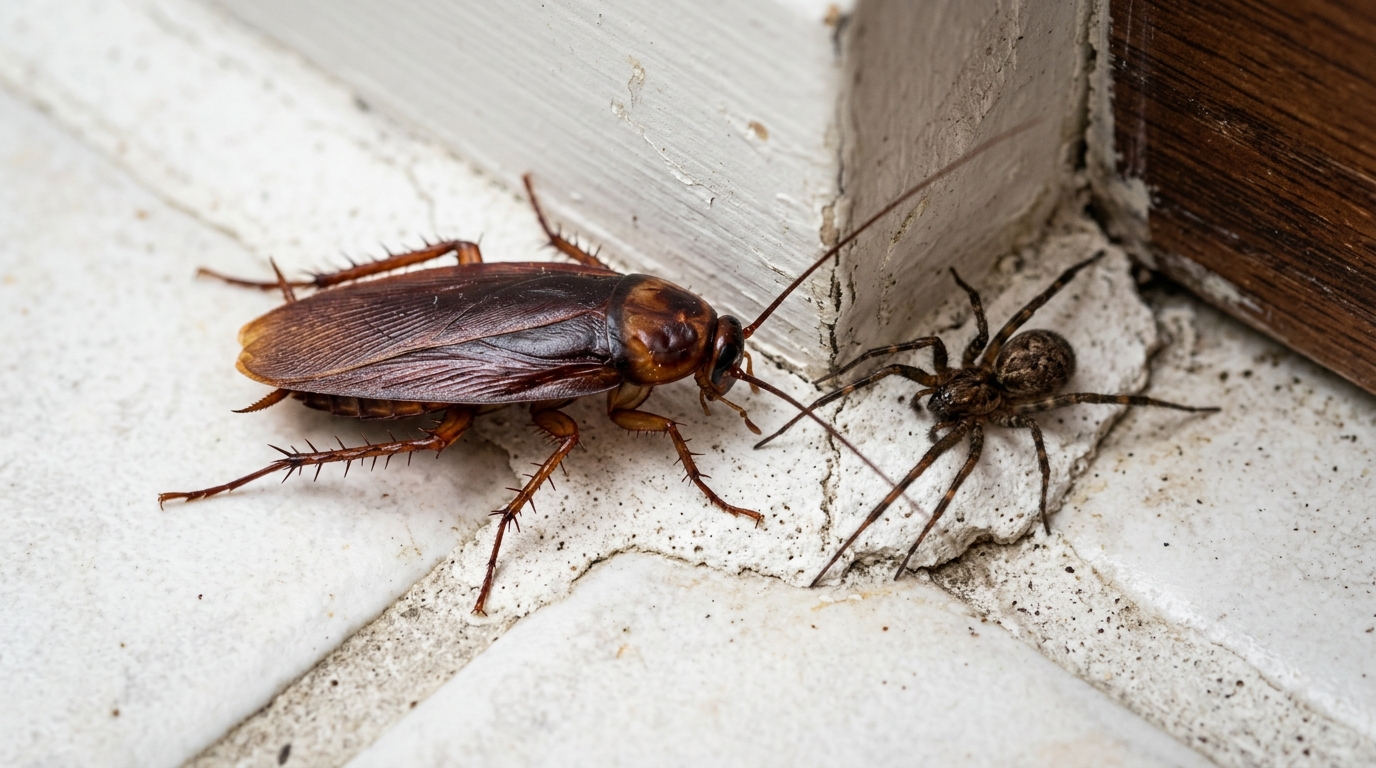
Who this guide is for and what you're deciding
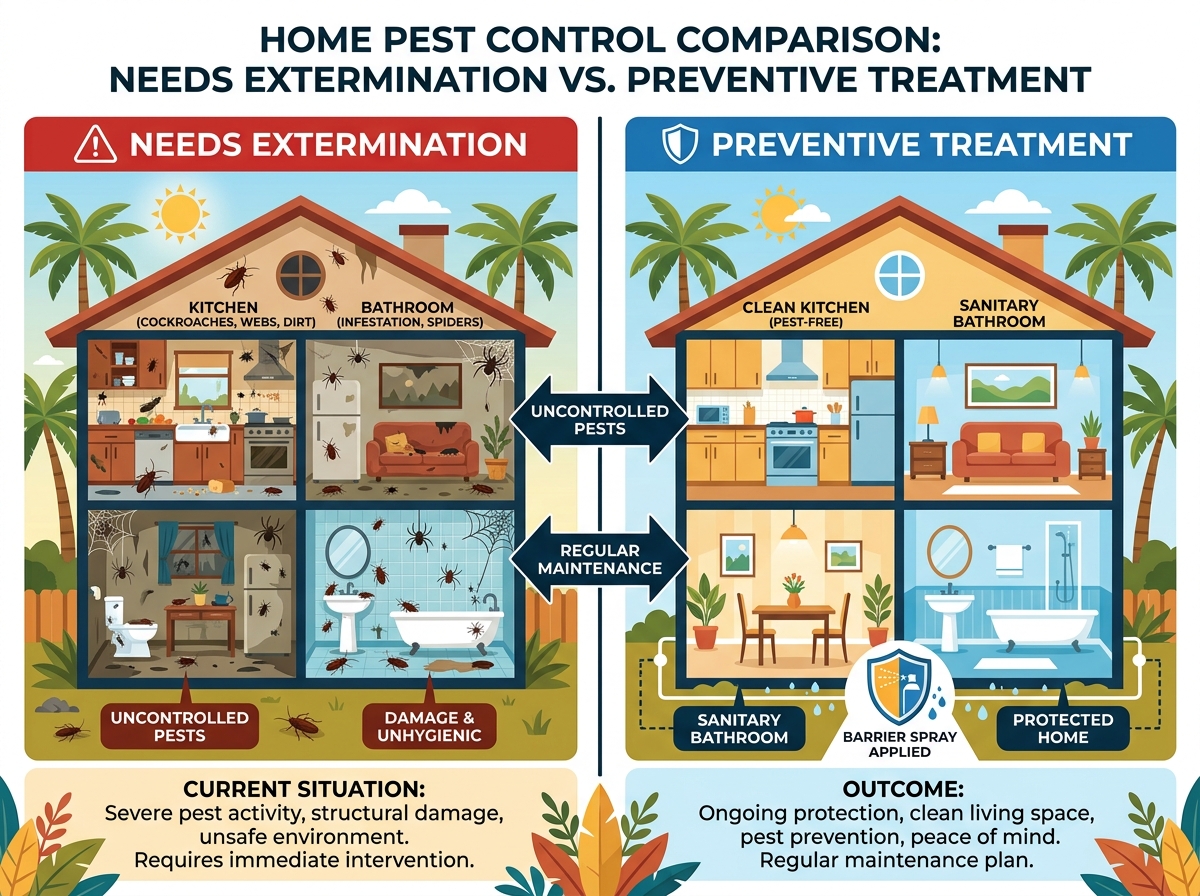
You have cockroaches in the kitchen and spiders in the garage, basement, or corners of the ceiling. You want someone out to treat both. Before you pick a provider, you are really deciding three things: does a company cover your address, does it treat both pests under one plan, and does the plan match your budget and timeline.
The decision most people skip
Homeowners usually call, describe the problem, then discover the provider does not reach their neighborhood. That order wastes a call. The smarter sequence is: confirm coverage, confirm both pests are included, then request pricing.
When you contact a provider or a matching service, expect a short intake. They will ask a few standard questions to route your request:
- Your ZIP code — the single most important field, because it decides whether anyone can be dispatched.
- Your address and city — used to confirm the service area and, later, to schedule.
- Your first name and a callback number — so a dropped call can be reconnected.
- Property type — single-family home, duplex, or apartment, because pricing and treatment differ.
- The pests you see — and whether there is "anything else" you notice a lot, since roaches often travel with other pests.
Answer the pest question honestly. If you also see mice or ants, say so. A combined plan is usually cheaper than separate visits. This guide follows that same order, so you close the coverage gap first and never repeat the frustrating loop of describing a problem to a company that cannot serve you.
Note that legitimate providers may record calls for quality assurance, and you always start the contact — no one calls you unprompted.
The gap most people hit: your ZIP code may not be covered
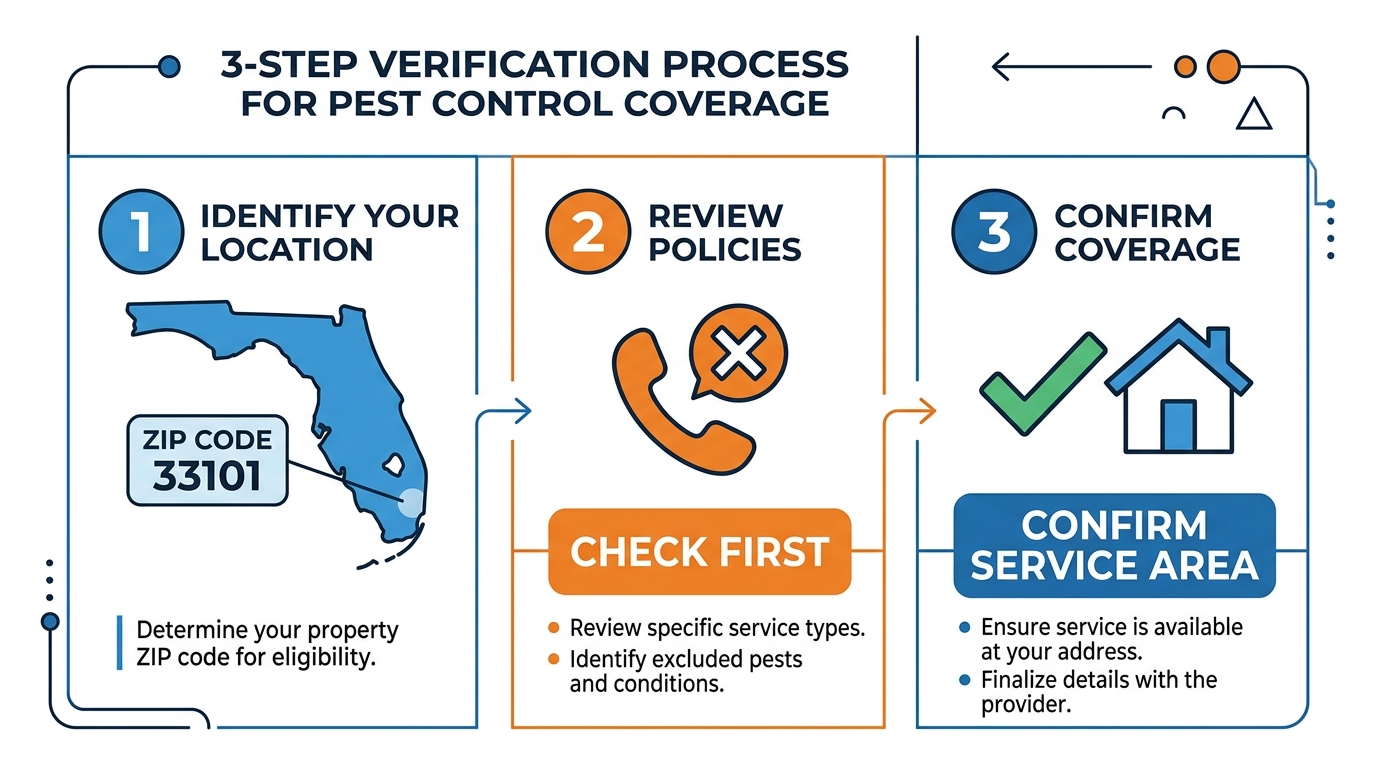
The most common surprise is simple: the company does not cover your ZIP code, and you only learn this after explaining everything. A national brand name does not mean national local service. Coverage is built branch by branch, and each branch runs routes only within a defined radius.
Why coverage has hard edges
Pest-control service areas are drawn around technician routes, licensing, and drive time. A provider listed "in Florida" may staff a Tampa or Orlando branch but skip rural counties an hour out. Franchises complicate this further: two towns 20 minutes apart can belong to different franchise owners with different price lists and different pest lists.
Check coverage before you describe the problem
Run this quick three-step check before you commit:
- ZIP check — enter your five-digit ZIP first and confirm at least one provider services it.
- Pest fit — confirm the provider treats both cockroaches and spiders, not one or the other.
- Estimate — only then share property details and request pricing.
If you live at a rural address and no provider covers it, ask for the nearest branch that does, or request a matching service that pulls from several companies. Independent county mosquito-control districts and university extension offices can also point you toward licensed operators nearby.
Verify a franchise's local coverage
Ask directly: "Is this address inside your service route, and are you the local franchise owner for my town?" Confirm the branch is licensed for structural pest control in Florida through the state's regulator, the Florida Department of Agriculture and Consumer Services. Our companion page, Pest Control Service Area Coverage by ZIP Code, walks through this verification in detail. Closing this gap first saves the repeat calls and dropped connections so many homeowners describe.
Recognizing the problem: roaches and spiders together
Cockroaches and spiders often appear together because spiders follow their prey. Where roaches, gnats, and moisture pests thrive, hunting spiders and web-builders soon settle in. Reading the signs correctly helps you describe the infestation accurately when you call.
Cockroach signs
In Florida homes, the two problem groups are German cockroaches (small, indoor, kitchen-driven) and larger American and smoky-brown cockroaches (outdoor, entering through gaps). Look for:
- Oothecae — the egg case, a tan or brown capsule holding 30–40 eggs, glued inside cabinet hinges, drawer runners, and appliance seams.
- Fecal specks — pepper-like dots or dark smears along shelf edges and behind the refrigerator.
- A musty, oily odor when a population grows large.
- Daytime sightings — roaches are nocturnal, so seeing them in daylight signals a heavy infestation.
Spider signs
Most Florida house spiders are harmless nuisance species. Watch for the two of medical concern: the southern black widow (glossy black, red hourglass, messy web low to the ground) and the brown recluse (rare in Florida, violin-shaped mark, prefers undisturbed storage). Signs include:
- Irregular cobwebs in corners, garages, and crawl spaces.
- Egg sacs — small silk balls tucked in webs.
- Spiders concentrating near lights or damp areas where insect prey gathers.
What the combination tells you
Seeing both usually means the home offers food, moisture, and entry points. Treating spiders alone rarely lasts, because they return to hunt available insects. Effective control reduces the prey base — roaches, ants, gnats — so spiders lose their reason to stay. This is why a single integrated plan beats one-off spider spraying.
What actually works, and when DIY fails
Effective roach and spider control follows Integrated Pest Management (IPM) — a strategy that combines inspection, sanitation, exclusion, and targeted products rather than blanket spraying. University extension programs and the EPA both promote this approach because it works longer and uses less pesticide.
How the products work
- Gel baits for German cockroaches. Roaches eat the bait, return to harborage, and die; others feed on the carcass and feces, spreading the active ingredient. Placement matters — small dots along cabinet edges, hinges, and appliance seams, not smeared lines.
- Insect growth regulators (IGRs). Compounds like hydroprene (sold as Gentrol) mimic juvenile hormone and stop nymphs from reaching breeding maturity. Others act as chitin-synthesis inhibitors, blocking the exoskeleton so molting fails. IGRs break the reproductive cycle over weeks.
- Residual perimeter treatments for spiders and larger roaches, applied to entry points and foundation lines. The EPA registers these products, and each label lists legal use sites.
- Web removal and exclusion. Physically sweeping webs and sealing gaps around pipes, vents, and door sweeps denies spiders shelter.
When DIY fails
Over-the-counter sprays often make German roaches worse. They scatter the population — called flushing — and drive survivors into wall voids. Some strains also show bait aversion, refusing baits with certain sugars, which is why professionals rotate active ingredients. Store sprays rarely reach the harborage where oothecae hide, so the cycle restarts in 30–45 days.
DIY struggles most when the infestation is established, when the property is a shared duplex or apartment where roaches migrate between units, or when moisture problems feed the population. A licensed technician inspects, identifies the species, and matches the product and the schedule. For pricing structure, see our service plans and pricing guide.
What to ask when requesting quotes
A useful quote depends on the questions you ask. Because German roach and spider work often needs an on-site inspection to price accurately, expect the provider to look before quoting a firm number. Bring these questions to the conversation.
Coverage and scope
- Does my ZIP code and street fall inside your service route?
- Are you the local branch or franchise owner for my town, and are you licensed for structural pest control in Florida?
- Does one plan cover both cockroaches and spiders, or are they billed separately?
- If I also see mice or ants, can they be added to the same plan?
Treatment and timeline
- What does the first visit include, and how long until I see results?
- How many follow-up visits are part of the initial knockdown for German roaches?
- Do you use gel baits and IGRs, or only sprays?
- What sanitation or repairs do you need me to handle first?
Plan structure and money
- Is this a one-time treatment or a recurring plan — monthly, bimonthly, or quarterly?
- What is the price difference between plan frequencies?
- What is the re-service policy if pests return between visits?
- Are there start-up or initial-visit fees separate from the recurring rate?
Ask for the re-service terms in writing. Reputable providers explain their retreatment policy plainly. Our page on treatment plans and how they work in Florida covers what those commitments typically include and their limits. Never accept a promise of "results" phrased as an absolute — biology varies, and honest providers describe expected outcomes and follow-up, not certainties.
Local notes for Florida homes
Florida's warmth and humidity make it one of the most pest-active states in the country. Roaches breed year-round here, and outdoor species like the American and smoky-brown cockroach press indoors during heavy summer rain and again during dry spells when they seek moisture.
Why Florida changes the plan
- Year-round pressure. Unlike northern states, there is no hard winter to knock populations back, so many Florida homeowners choose recurring plans over one-time visits.
- Moisture harborage. Slab construction, screened lanais, and irrigation create the damp edges where both roaches and spiders gather. Fixing leaks and adjusting sprinkler runoff supports every treatment.
- Entry points. Palmetto bugs — a common name for smoky-brown and American roaches — enter through weep holes, garage gaps, and gutter debris. Exclusion matters as much as spraying.
Licensing and verification
Florida requires structural pest-control operators to be licensed. Verify any provider through the Florida Department of Agriculture and Consumer Services, which regulates the industry, and consult UF/IFAS Extension for species identification and IPM guidance specific to the state.
Metro coverage
Provider density is highest in the large metros. If you live in or near a city, start with these local pages: Jacksonville, Miami, Orlando, Tampa, and West Palm Beach. Rural and inland addresses have fewer routes, so the ZIP-code check matters most there. For a statewide overview, see our Florida pest control guide.
Cost factors: what shapes your price
No honest guide can quote a firm price without an inspection, but the factors that move the number are consistent. Understanding them helps you read a quote and compare providers fairly.
What raises or lowers the estimate
- Infestation severity. A light spider presence costs less than an established German roach population needing several follow-up visits.
- Home size and layout. More linear feet of foundation, more cabinets, and more bathrooms mean more product and labor.
- Property type. A single-family home is priced differently from a duplex or apartment, where roaches migrate between units and complicate control.
- Plan frequency. Recurring plans spread cost across the year; per-visit rates on quarterly plans usually run lower than one-time calls, while monthly plans cost more per year but hit heavy roach cases harder.
- Number of pests. Bundling roaches, spiders, and any rodents into one plan is generally cheaper than separate services.
- Access and prep. Cluttered kitchens and blocked crawl spaces slow technicians and can add cost.
How to compare fairly
Line up quotes by total annual cost and visit count, not the initial-visit price alone. A low first visit can hide a high recurring rate. Ask each provider to itemize the start-up fee, the recurring rate, and the re-service policy. For a deeper breakdown of Florida pricing structure, see our Florida cost planning guide and how to get a pest control quote in Florida. These explain the ranges and drivers without fake numbers, so you know a fair figure when you see one.
Common questions
How do I check if a provider covers my ZIP code before I call?
Enter your five-digit ZIP code first and confirm at least one provider services it. Only then describe the pests and request pricing. This order avoids the common frustration of explaining an infestation to a company that cannot dispatch to your address.
Can one plan treat both cockroaches and spiders?
Usually yes. Reducing the insect prey base — roaches, ants, gnats — removes the food spiders hunt, so integrated plans handle both. Ask the provider directly whether both pests are included or billed separately, and add any rodents to the same plan if you see them.
What if no provider covers my rural address?
Ask each company for the nearest branch that does reach your area, or use a matching service that pulls from several providers at once. Your county's cooperative extension office and independent mosquito-control districts can also point you toward licensed operators nearby.
How do I verify a franchise's local coverage and license?
Ask whether your street sits inside their service route and whether they are the local franchise owner for your town. Confirm the branch holds a structural pest-control license through the Florida Department of Agriculture and Consumer Services before scheduling.
Why did store-bought roach spray make the problem worse?
Sprays scatter German roaches into wall voids — called flushing — and rarely reach the egg cases hidden in cabinet hinges and appliance seams. Some strains also avoid certain baits. Professionals rotate gel baits and growth regulators to break the reproductive cycle instead.
Will I get an exact price over the phone?
Often not for German roaches or heavy infestations, which usually need an on-site inspection to price accurately. Expect a firm quote after a technician looks. You always start the contact, and calls may be recorded for quality assurance.
Related: Pest Control Service Area Coverage by ZIP Code · Cockroach Control in Florida · Spider Control in Florida · Florida pest control guide · How to Get a Pest Control Quote in Florida