Mice in Your Home and Need a Professional? Start by Checking ZIP Coverage
If you have mice and need professional help, the first step is not the phone call — it is confirming a provider covers your ZIP code. Many callers reach a company only to learn their address sits outside the service area. Check coverage first, describe the problem clearly, then compare quotes.
Calls may be recorded for quality and matching purposes.

Who this is for and what you are deciding
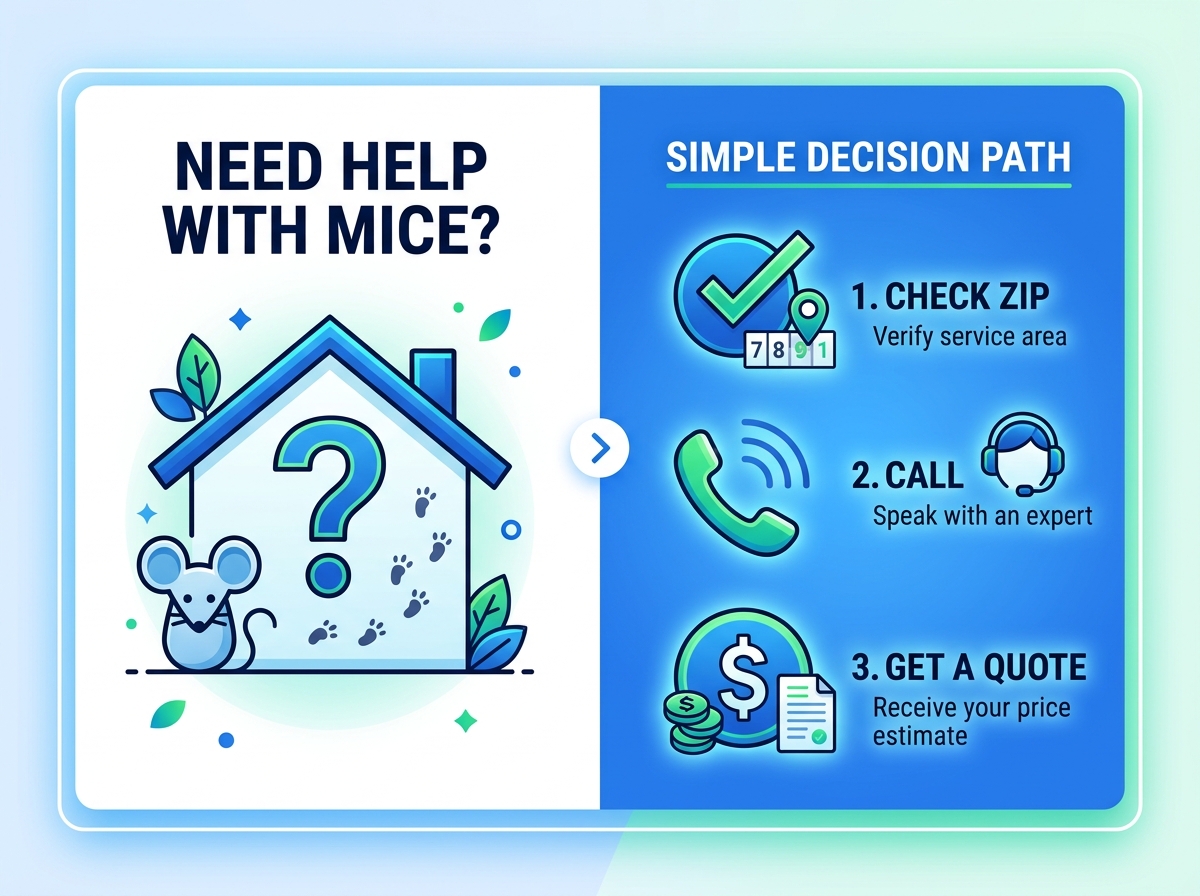
This guide is for a homeowner who has spotted mice and now needs a professional. You have seen droppings, heard scratching, or watched a small, gray-brown rodent dart along a baseboard. You are deciding two things at once: whether to keep trapping yourself, and which company can actually treat your home.
That second decision trips up more people than the first. A common call goes like this: the homeowner describes the mice, gives an address, then hears the company does not cover that city. The person on the line offers to route the call elsewhere — "I can get you sent over to someone who can help you out" — and the search restarts.
Confirm coverage before you invest time in a call. Providers draw a service area around their branch locations. A ZIP code a few miles past that boundary may sit outside their route, especially for rural addresses. When a company asks "What city are you in?" early, they are checking the same thing you should check first.
The order that saves you time
- Step 1: Verify ZIP-code coverage with each provider.
- Step 2: Confirm they treat rodents (some quote termites or general pests only until you ask).
- Step 3: Describe the problem — mice, plus anything else you see a lot, such as roaches.
- Step 4: Compare quotes and plan structure.
HomePest Match is an independent matching guide, not a pest-control company. We do not send technicians or offer services. We help you understand the process and reach providers who cover your address. You always start the contact; nothing here is a service offer.
The gap most callers hit: service areas are limited by ZIP code
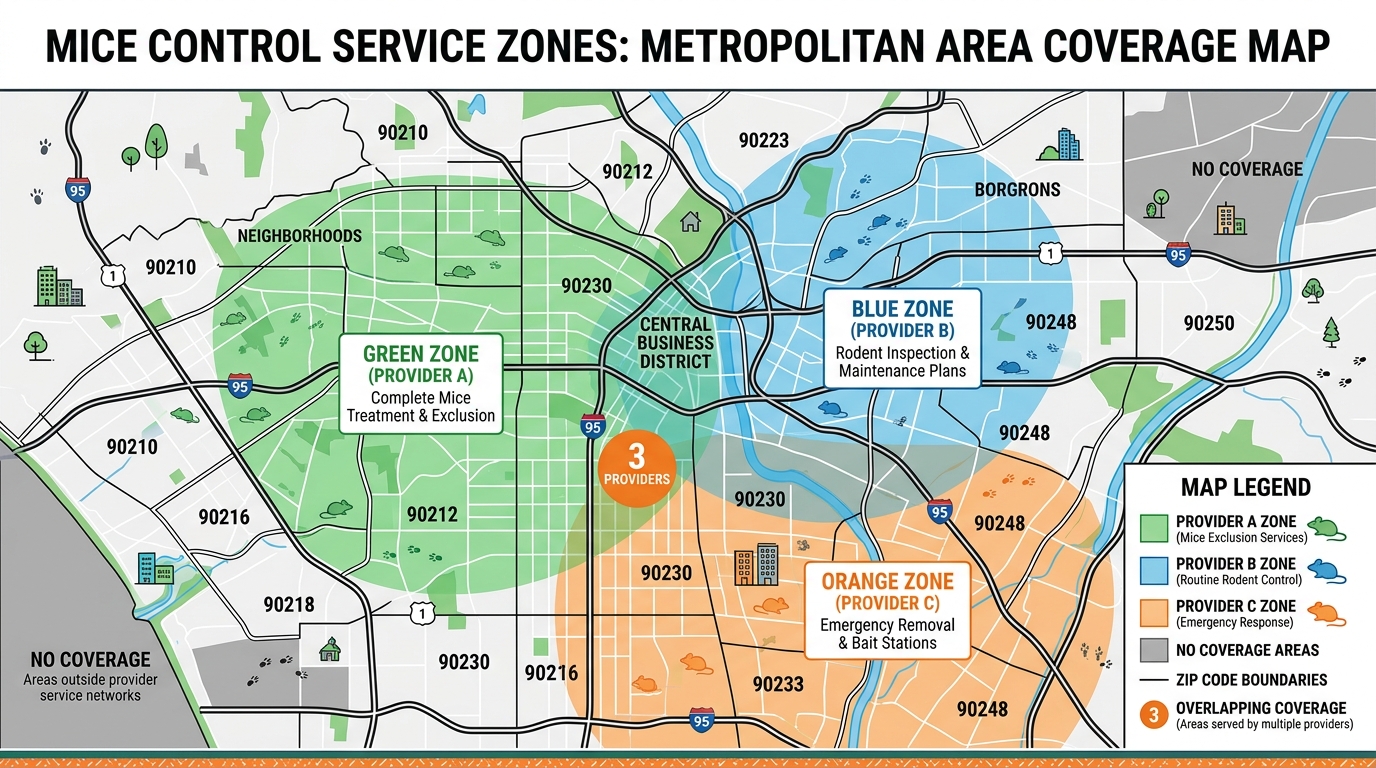
The single biggest surprise for a mice caller is this: a provider's service area is limited, and your ZIP code may fall outside it. People assume a national brand covers everywhere. It does not. Coverage follows branch locations and the routes technicians drive.
Here is why the boundary exists. A pest-control branch schedules technicians along efficient routes. An address 20 minutes past the last stop adds drive time that breaks the route economics. So the company sets a service-area map, often defined by a list of ZIP codes tied to each branch. Your address is either on that list or it is not.
Why the phone tree asks for your ZIP first
Many providers open with an automated prompt: "Enter the five-digit ZIP code where you would like to receive services." That is a coverage filter running before a human speaks to you. If your ZIP is not served, the system may route you to a referral partner instead. Knowing this, you can save the whole call by checking coverage up front.
How to check ZIP coverage before you commit
- Use a coverage checker. Enter your exact five-digit ZIP, not just your city name. Cities can span served and unserved ZIPs.
- Ask directly: "Do you service my ZIP code and treat mice?" Get a yes before describing the problem in detail.
- Line up two or three providers in case the first says no.
Our companion guide, Pest Control Service Area Coverage by ZIP Code, walks through this check step by step. If no provider covers a rural address, ask each company to refer you to a partner, and search independent local operators who serve outlying routes. Provider service limits also vary by pest and property type, as our service-limits guide explains.
Signs you have mice and how bad it is
House mice (Mus musculus) leave clear, readable evidence. Learning to grade the signs tells you whether traps will hold the line or whether the population needs professional pressure.
Droppings
Mouse droppings are rod-shaped, dark, and small — about 3 to 6 millimeters, roughly the size of a grain of rice. Fresh droppings look moist and dark; older ones dry gray and crumble. Concentrated droppings along one wall or inside a drawer mark an active runway.
Sound and sight
Scratching or scampering inside walls and ceilings, usually at dusk and after dark, signals nesting. Mice are nocturnal, so daytime sightings often mean the population has grown enough to push activity into daylight.
Gnaw marks and grease trails
Mice gnaw constantly to file their incisors, which never stop growing. Look for chew damage on food packaging, baseboards, and wire insulation. Along heavily used paths, body oils leave faint gray smudges called rub marks.
Nests and odor
Nests are loose balls of shredded paper, fabric, and insulation, tucked behind appliances, in wall voids, or in stored boxes. A strong, musky ammonia smell points to urine buildup and a sizable colony.
How to grade severity
- Light: a few droppings in one spot, occasional night sounds — trapping may control it.
- Moderate: droppings in several rooms, gnaw damage, repeat catches over a week.
- Heavy: daytime sightings, strong odor, nests found — a professional program is warranted.
The U.S. Centers for Disease Control and Prevention notes that mice can carry pathogens and contaminate food; disturbing nests and droppings without care raises exposure risk. When you see mice, ask yourself what else you notice a lot — roaches often share the same warm, food-rich spaces, and one visit can address both.
What actually works, and when DIY fails
Mouse control succeeds when you combine exclusion, sanitation, and targeted removal. That framework is the core of Integrated Pest Management, or IPM — a strategy that pairs prevention with the least-toxic effective control, defined by university extension programs.
Exclusion: the step that ends the cycle
Mice enter through gaps as small as a quarter-inch — about the width of a pencil. Seal foundation cracks, gaps around pipes and utility lines, and worn door sweeps. Stuff copper mesh or steel wool into holes before sealing, because mice chew foam and caulk alone. Exclusion is the only step that stops new mice from replacing the ones you remove.
Sanitation
Store food in sealed containers, clear clutter that offers harborage, and remove water sources. A colony that loses food and shelter shrinks or moves on.
Trapping and baiting
Snap traps kill quickly and let you confirm catches. Place them perpendicular to walls, trigger side against the baseboard, along runways marked by droppings. Rodenticide baits are registered pesticides; the U.S. Environmental Protection Agency regulates their use and packaging to limit risk to children, pets, and wildlife. Follow every label direction — the label is federal law.
Why DIY fails
- Missed entry points. You remove mice, but new ones enter through gaps you never found.
- Hidden harborage. Nests in wall voids and attics stay out of reach of hardware-store traps.
- Reproduction outpaces trapping. A female mouse can produce multiple litters a year, so a slow trap line loses the race.
- Bait misuse. Poorly placed rodenticide can kill a mouse inside a wall, creating odor, or expose non-target animals.
A professional performs a structured inspection, seals entry points, sets a monitored program, and returns to verify results. When droppings spread across rooms, when you hear activity in walls, or when catches keep coming, the population has passed the point where DIY reliably wins.
What to ask when you request quotes
Once you confirm a provider covers your ZIP and treats rodents, the quote conversation gets efficient. Ask focused questions so you compare offers fairly. Note that many providers record calls for quality assurance — that disclosure is standard and legal in most settings.
Coverage and scope
- "Do you service my exact ZIP code?" Confirm before anything else.
- "Does the plan cover mice specifically, and what else is included?" Many plans bundle common pests like roaches and ants. If you see more than mice, say so.
- "Do you seal entry points, or only set traps and bait?" Exclusion is what makes control last.
Process and follow-up
- "What does the first visit include?" Look for inspection, exclusion, and initial removal.
- "How many follow-up visits, and are they included?" Rodent programs usually need return visits to monitor and adjust.
- "How do you handle a mouse that dies inside a wall?" A serious provider has an answer.
Plan structure and terms
- "Is this a one-time service or a recurring plan?" Compare quarterly versus monthly structures.
- "What is the cancellation policy and contract length?"
- "Is your company licensed for structural pest control in this state?" Licensing is handled by each state's regulatory board; you can verify a company through your state department of agriculture.
For a deeper walkthrough of describing the problem and comparing offers, see What to Expect When You Report a Pest Problem and our overview of service plans and pricing. Line up two or three covered providers so one "no" on coverage does not stall your whole search.
What shapes the cost of mouse control
We do not publish fixed prices, because rodent quotes turn on your specific home. Instead, learn the factors that move a quote up or down so you can read an estimate with confidence.
Severity and spread
A light problem in one room costs less to control than a colony spread across kitchen, attic, and basement. More activity means more traps, more visits, and more exclusion work.
Home size and construction
Square footage and the number of stories affect labor. Older homes with fieldstone foundations, crawl spaces, and many utility penetrations offer more entry points, which raises exclusion cost.
Exclusion scope
Sealing entry points is often the largest variable. Labor to install door sweeps, seal foundation gaps, and screen vents scales with how many openings your home presents.
Service structure
- One-time service addresses the current problem but does not monitor for reentry.
- Recurring plans (monthly or quarterly) spread cost and include return visits. Quarterly plans usually cost less per year; monthly plans give faster response.
Add-on pests and cleanup
Bundling roaches or ants into one plan changes the number. Contamination cleanup — sanitizing droppings, removing soiled insulation — adds cost but reduces health risk, in line with CDC guidance on safe cleanup.
Location and access
Rural or hard-to-reach addresses can carry higher travel-driven pricing, and some providers will not route to distant ZIPs at all. That ties back to coverage: confirm service first, then discuss price. For factor-by-factor context, our service plans and pricing guide shows how these variables combine into a real estimate.
Common questions
What if no provider covers my rural address?
Ask each company you call to refer you to a partner who serves outlying routes. Then search independent local operators, since small regional firms often cover ZIPs the large branches skip. Confirm the referral treats rodents before you describe the problem in detail.
How do I verify a company covers my ZIP code before calling?
Enter your exact five-digit ZIP into a coverage checker rather than searching by city name, because one city can span served and unserved ZIPs. When you call, ask "Do you service my ZIP and treat mice?" and get a yes first. Our ZIP coverage guide walks through the full check.
How do I verify a franchise actually covers my area?
A national brand name does not guarantee local coverage. Ask the specific branch that would service you to confirm your ZIP is on their route list. You can also verify the company holds a structural pest-control license through your state department of agriculture.
Should I mention other pests when I call about mice?
Yes. If you also see roaches or ants a lot, say so up front. Many plans bundle common pests, and one visit can address several problems, which often costs less than separate services.
When should I stop trapping myself and call a professional?
Call when you see daytime sightings, a strong musky odor, droppings across several rooms, or catches that keep coming after a week of trapping. Those signs mean the population is reproducing faster than a trap line can control it.
Will a company call me back if I leave my address?
You always start the contact. When you reach a provider, they check your ZIP and describe next steps during the call you place. Confirm coverage and scope before scheduling anything.
Related: Pest Control Service Area Coverage by ZIP Code · pest control provider service limits · What to Expect When You Report a Pest Problem · service plans and pricing