Mosquito and Rodent Infestation in the Home: When You Have Both at Once
When you have both mosquitoes and rodents at home, one call rarely solves both. Before you dial, check that a provider actually covers your ZIP code, because many callers reach a company that cannot serve their address. This guide shows how to confirm coverage first, then treat each pest correctly.
Calls may be recorded for quality and matching purposes.
Who this is for and what you are trying to decide
This guide is for the homeowner facing two problems at once: mosquitoes breeding around the house and rodents inside walls, the attic, or the crawl space. You want a provider, and you want the visit to fix both without three separate contracts.
The decision has three parts. First, confirm a company serves your address, because coverage is drawn by ZIP code and not every ZIP has an active provider. Second, decide whether the same company handles both pests or whether you need a general-pest plan plus a mosquito program. Third, decide between a one-time service and recurring service, since mosquitoes return seasonally and rodents test your exclusion work for months.
Callers often open with, "I'd like to get a quote," and are asked, "a quote for what exactly?" That question matters here. A vague request slows the match. A clear one moves faster:
- Name the pests: "mosquitoes outdoors and rodents in the attic."
- Name the property type: home versus business.
- Give your ZIP code first: it decides whether the rest of the call can proceed.
HomePest Match is an independent information and matching service, not a pest-control company. We do not treat homes. We help you understand the work, prepare good questions, and connect with licensed providers who serve your area. You always start the contact. For how the intake works, see our guide on what to expect when you report a pest problem.
By the end, you should know how to verify coverage, describe both pests accurately, and judge a quote for a combined job.
The mistake almost no one expects: your ZIP code may have no available provider
Here is the gap most homeowners never see coming. You find a company, you rehearse your problem, you dial, and after the phone tree and the recorded quality-assurance notice, an agent asks for your ZIP code. Then comes the sentence that ends the call: the address is outside the service area. Sometimes you are transferred with a polite, "I'll send you over now," and you start again from zero.
Coverage is not national or even citywide. Providers draw service areas — the set of ZIP codes a company will physically dispatch a technician to. A ZIP a few miles from a busy metro may sit outside every nearby branch's route. Rural addresses are the most likely to fall in a gap. So are new subdivisions whose ZIP codes are recent.
Why coverage fails at the ZIP level
- Route economics: a technician must reach you, treat, and return within a scheduled day; distant ZIPs break the route.
- Branch boundaries: a franchise brand may show a national number, but each local branch owns only certain ZIPs.
- Licensing lines: some companies operate only where they hold the right state license and business registration.
Check coverage before you describe the pests
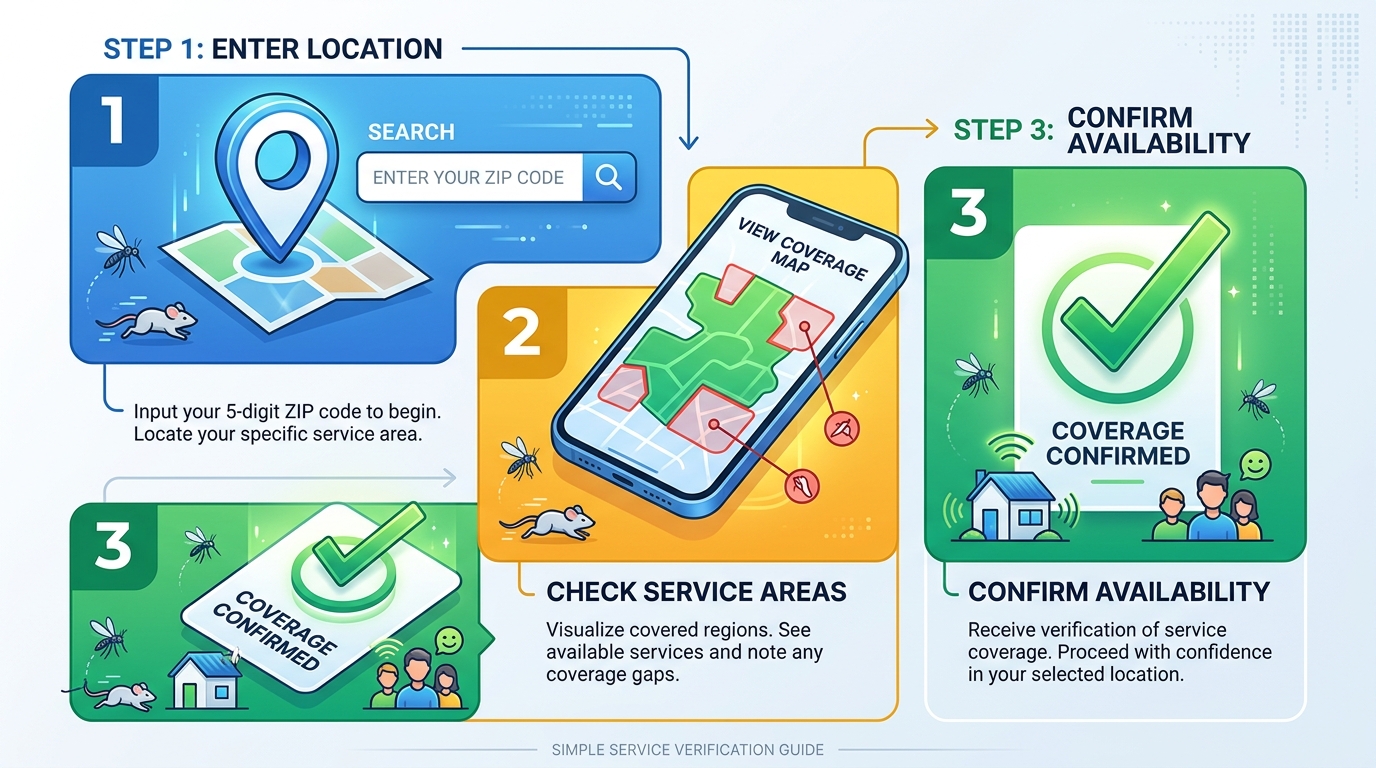
Reverse the usual order. Give your five-digit ZIP first, then your pests. If the answer is "you're in our service area," continue. If not, ask to be matched with a company that covers your address rather than repeating your story to transfers.
Our companion page, Pest Control Service Area Coverage by ZIP Code, walks through the ZIP-check step in detail. Think of it as a simple flow: ZIP check → pest fit → estimate. Clear that first gate and the rest of the call is about the work, not your location.
Signs you truly have both — mosquito and rodent — at the same time
Two infestations can hide behind each other. Confirm both before you request service so the quote covers everything.
Rodent signs (rats and house mice)
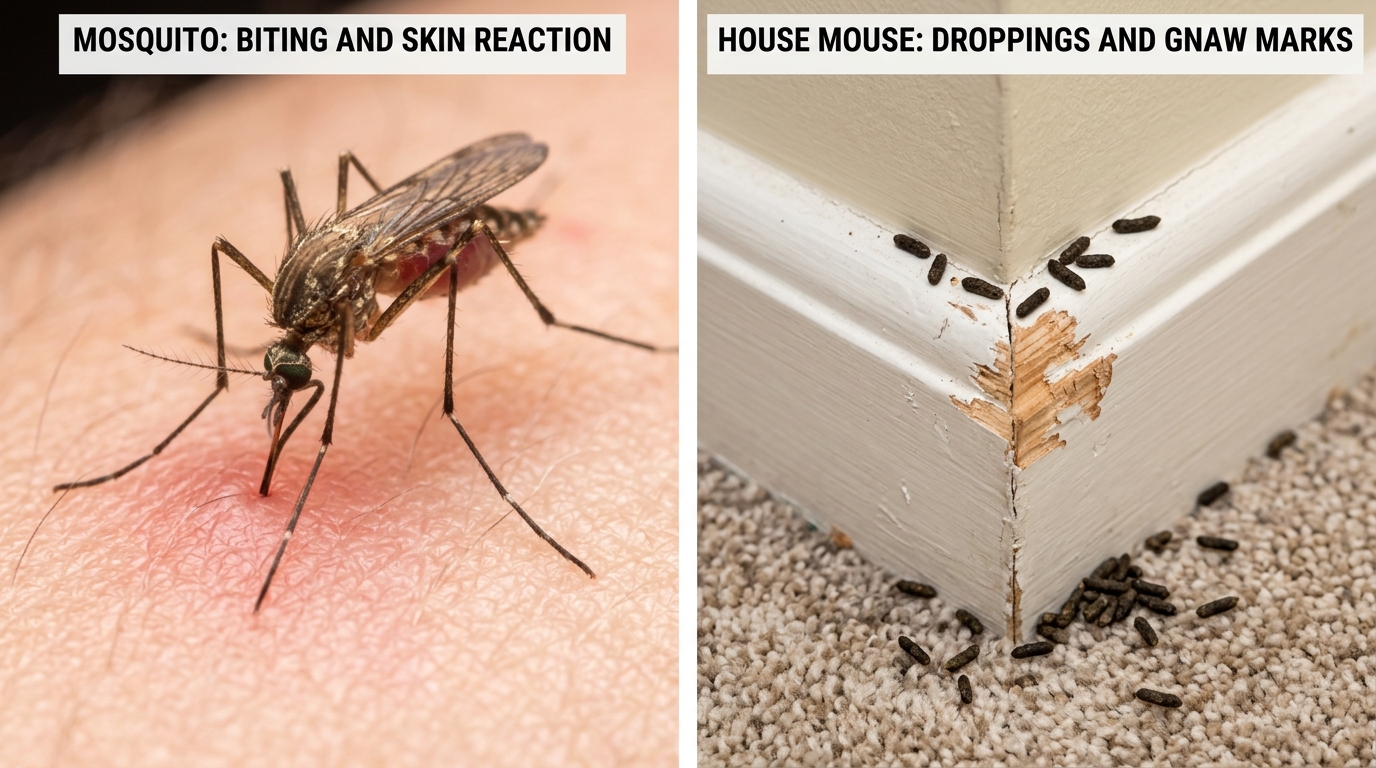
- Droppings: mouse droppings are rice-grain sized; rat droppings are larger, like a raisin. Fresh droppings are dark and soft.
- Gnaw marks: rodents chew wood, wire, and plastic to keep incisors filed. Chewed wiring is a fire risk the CDC and fire authorities both flag.
- Rub marks: greasy dark smears along baseboards and beams where fur meets surfaces on runways.
- Sounds: scratching or scurrying in walls, ceilings, and the attic, usually at dusk and night.
- Nests: shredded paper, insulation, or fabric in hidden voids.
Mosquito signs
- Daytime biting: the Asian tiger mosquito (Aedes albopictus) has striped legs and bites in daylight, close to the house.
- Standing water: larvae, called wrigglers, live in any water held for about a week — gutters, saucers, buckets, bottle caps.
- Indoor mosquitoes: adults resting on walls in shaded rooms, often near doors or a damp basement.
Why the two problems overlap
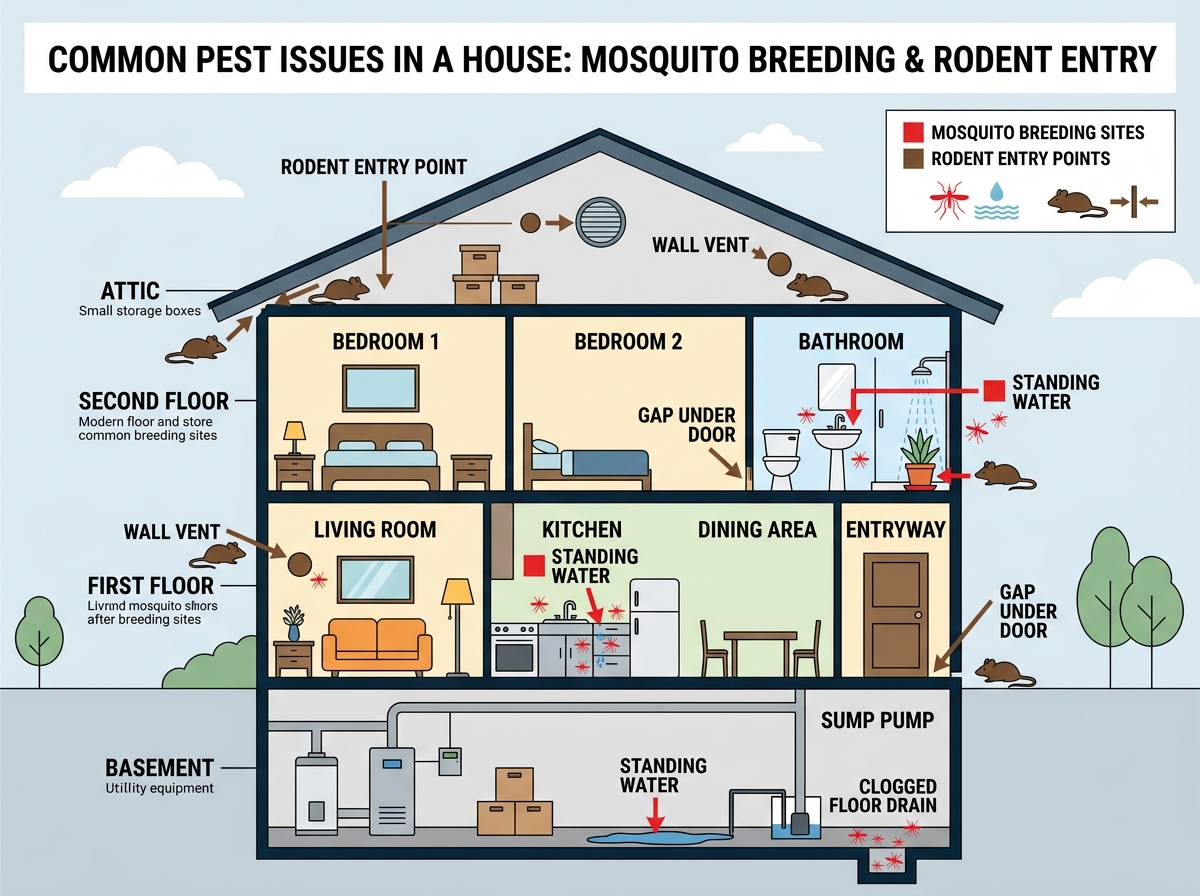
Moisture ties them together. A clogged gutter breeds mosquitoes and softens fascia that rodents exploit. A damp crawl space draws rodents and holds pooled water where mosquitoes lay eggs. When you find one, inspect for the other. If you are unsure which insect you have — the caller who said, "I don't know how to identify bugs" is common — describe size, leg markings, and where you see them. For deeper species notes, see mosquito control basics and rodent control basics.
What actually works — and where DIY runs out
The two pests need different mechanisms. A good combined plan uses Integrated Pest Management (IPM) — a strategy from university extension programs that pairs habitat removal, exclusion, monitoring, and targeted product use rather than spraying alone.
Rodents: exclusion first, then removal
Killing the rodents you see does nothing if the entry stays open. The durable fix is exclusion — sealing gaps a rodent can pass. A house mouse fits through a hole about a quarter inch; a rat needs about a half inch. Technicians seal with steel wool packed in caulk, hardware cloth, and rodent-proof sealant, then set snap traps or tamper-resistant bait stations along runways. The U.S. Environmental Protection Agency regulates rodenticides and restricts loose pellets, so licensed use of enclosed stations matters.
Mosquitoes: kill the water, then the adults
Source reduction is the highest-value step: empty or drain any water held about a week. Where water cannot be removed, technicians apply larvicides such as Bti (Bacillus thuringiensis israelensis), a bacterium toxic to larvae but not to people or pets at label rates. Barrier sprays on shaded foliage knock down resting adults. Both product types must be EPA-registered.
When DIY fails
- Hidden rodent entries: homeowners seal visible holes and miss roof-line gaps and utility penetrations, so the problem returns.
- Missed breeding sites: one overlooked clogged gutter re-seeds the yard within days.
- Bait shyness and resistance: mis-placed rodent bait teaches avoidance; store sprays hit adults but ignore larvae.
Persistent activity after two or three weeks of honest effort is the signal to bring in a licensed provider.
What to ask when you request quotes for both pests
A combined mosquito-and-rodent job has more moving parts than a single-pest visit. Ask precise questions so the estimate is real and comparable. Providers will also ask for basics — your first and last name, the service address, and the ZIP code — so have those ready to speed the match.
Coverage and scope
- Does your service area include my ZIP code, and does the same technician handle both mosquitoes and rodents?
- Is rodent exclusion (sealing entry points) included, or only trapping and baiting?
- Does the mosquito service include source reduction and larviciding, or only adult barrier spray?
Products and safety
- Which EPA-registered products will you use, and are rodent baits in tamper-resistant stations?
- What are the re-entry intervals for children and pets after a mosquito application?
Plan structure and follow-up
- Is this a one-time service or recurring? Mosquitoes are seasonal; rodents need follow-up checks.
- How many visits are included, and what triggers a return visit within the plan?
- What does the written service plan say about scope and re-treatment terms?
Get every promise in writing. Note that calls to providers may be recorded for quality assurance, and that you always initiate contact — no one should promise to call you back as the plan. For structure and terms, see our guide to pest control service plans and pricing.
Cost factors for a combined mosquito-and-rodent job
We do not publish set prices, because a combined job depends on your home. Here are the concrete factors that move the number, so you can read a quote critically instead of guessing.
What raises a rodent estimate
- Extent of exclusion: sealing many entry points and installing hardware cloth is labor-heavy versus setting a few traps.
- Access: attics and tight crawl spaces take longer and may need protective work.
- Cleanup: droppings and contaminated insulation removal add scope.
- Follow-up visits: rodent programs usually schedule return checks to confirm the population is gone.
What raises a mosquito estimate
- Yard size and vegetation: more shaded foliage means more barrier-treatment area.
- Standing-water sources: persistent water may need repeat larviciding.
- Season length: a recurring program spanning the warm months costs more than a single visit but holds pressure down.
Why bundling can help
Booking both pests with one provider can trim trip charges, since a single technician addresses two problems per visit. Weigh a recurring plan against one-time service: mosquitoes rebound each season and rodents test new gaps, so periodic monitoring often costs less than repeated emergency calls. For a general planning framework and comparable examples, see our overview of multi-pest treatment pricing and scheduling. Always compare written quotes on identical scope — same exclusion work, same product types, same number of visits — so you compare like with like.
Common questions
What if no provider covers my rural address?
Give your ZIP code first on the call. If it falls outside every nearby service area, ask to be matched with a company that does cover your address instead of repeating your story through transfers. Independent county mosquito or vector-control districts may also assist with outdoor mosquito issues in some areas.
Can one company treat both mosquitoes and rodents in one visit?
Often yes, if the provider offers both a general-pest or rodent program and a mosquito program. Ask whether the same technician handles both and whether rodent exclusion is included. Bundling can reduce trip charges.
How do I check a franchise brand's local coverage?
A national phone number does not mean your ZIP is served. Each local branch owns specific ZIP codes and holds a state license for its territory. Confirm your five-digit ZIP is in that branch's service area before describing the pests.
Why do mosquitoes and rodents show up together?
Moisture links them. Clogged gutters and damp crawl spaces breed mosquito larvae and soften structures that rodents exploit for entry. Fixing the moisture and sealing gaps helps both problems at once.
Should I choose one-time or recurring service?
Rodents need follow-up visits to confirm removal after exclusion, and mosquitoes return each warm season. Recurring monitoring usually costs less over time than repeated emergency calls. Match the plan to how persistent each problem is at your home.
What information should I have ready before I call?
Have your ZIP code, service address, and full name ready, plus a clear description of both pests and where you see them. Note that provider calls may be recorded for quality assurance, and you always start the contact yourself.
Related: Pest Control Service Area Coverage by ZIP Code · mosquito control basics · rodent control basics · pest control service plans and pricing · what to expect when you report a pest problem