California Pest Control Cost in 2026: A Quarterly Pricing Guide for Spiders and Roaches
Quarterly pest control in California usually runs as a published range, not one fixed price, because size, pest, and access change the number. This guide shows how quarterly service compares to monthly and one-time visits. It closes the biggest gap most callers have: what a fair price and schedule actually look like.
Calls may be recorded for quality and matching purposes.
Who this guide is for and what you're deciding

You have spiders in the garage and roaches near the kitchen sink, and you want a straight answer on price and how often a technician should come. That is the exact decision this guide helps you make. HomePest Match is an independent matching and information service, not a pest control company, so the numbers here are published ranges and cost factors, never a live quote.
Most California callers land in one of three situations:
- First-time buyer: you have never paid for pest control and want to know if quarterly service is enough for spiders and roaches.
- Comparison shopper: you already have one estimate and want to judge whether it is fair.
- Escalating problem: you tried sprays from the hardware store and the roaches came back.
The core question is frequency versus cost. Quarterly service means four visits a year, spaced about every 90 days. Monthly service means twelve visits. A one-time treatment is a single visit with no ongoing coverage. Each model fits a different problem, and picking wrong wastes money.
Here is the decision rule that guides the rest of this page. Occasional spiders and a light roach sighting usually fit a quarterly plan. An active, breeding roach population, especially German cockroaches indoors, usually needs a tighter schedule at first. Understanding why lets you read any California estimate with confidence. You will also learn what to ask so a provider cannot pad the price with vague language. When you are ready to describe your problem clearly, our guide on how to report a pest problem helps you gather the right details first.
What California homeowners misunderstand about pricing and frequency
This is the gap that drives most calls: people assume pest control has one flat price, and they assume more visits always mean better results. Both beliefs are wrong, and both cost money.
Price is a range, not a sticker
No honest provider quotes a firm dollar figure before knowing your square footage, pest type, and property layout. In California, quarterly general pest plans are commonly published as a per-visit range with a slightly higher first, or "initial," visit. The initial visit costs more because it includes inspection, heavier product application, and often exterior perimeter treatment. Later quarterly visits maintain that barrier and cost less. When someone gives you a single number sight unseen, treat it as a placeholder, not a quote.
Frequency should match the pest's biology
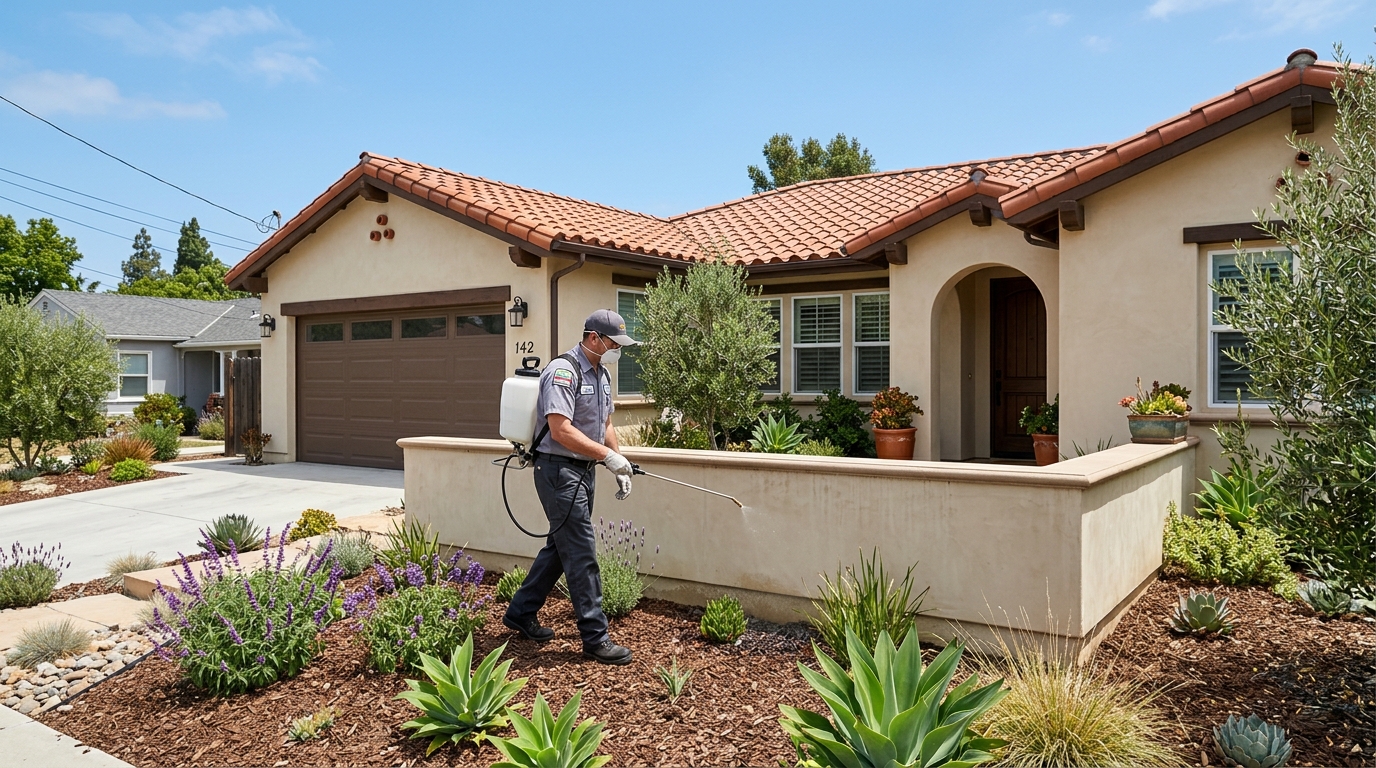
Spiders are largely a perimeter and exterior problem. A residual barrier sprayed around the foundation, eaves, and entry points every 90 days stays effective because it knocks down the insects spiders feed on. That is why quarterly service handles most California spider issues well.
Roaches are different. German cockroaches breed indoors and complete an egg-to-adult cycle in weeks. One egg case, called an ootheca, can carry 30 to 40 eggs. A single quarterly visit cannot outpace that reproduction. Getting them under control usually takes two or three visits spaced about two weeks apart, targeting the nymphs that hatch after the first treatment. After the population crashes, a quarterly plan keeps it down.
The real misunderstanding
The mistake is buying frequency to feel safe instead of matching it to the pest. Paying monthly for occasional spiders wastes cash. Paying quarterly for an active roach breeding site fails to solve the problem. Match the schedule to the biology and you pay for results, not visits.
Signs that tell you which service level you need
Before you compare prices, read your own house. The signs below sort a light problem from an active infestation, and that sorting decides your plan.
Spider signs (usually quarterly-ready)
- Webs in garage corners, eaves, window frames, and fence lines.
- Sightings mostly at the perimeter, not deep inside living space.
- More activity in late summer and fall, common across California.
Most California spiders are nuisance species. Watch for the western black widow, glossy black with a red hourglass, in woodpiles, meter boxes, and under patio furniture. Its presence raises the priority but not usually the frequency.
Roach signs (may need a tighter start)
- Daytime sightings: roaches are nocturnal, so seeing them in daylight signals a crowded, larger population.
- Egg cases: small brown capsules glued in cabinet hinges, behind appliances, or along drawer seams.
- Droppings: German cockroaches leave pepper-like specks; larger species leave grains resembling coarse ground coffee.
- Musty odor: a strong population produces a distinct smell.
How to read the count
A rough field guideline many technicians use: seeing a handful of roaches, and never in daylight, often fits a single corrective visit followed by quarterly maintenance. Frequent sightings, daytime activity, or visible egg cases point to an established population that needs an initial treatment plus follow-ups before quarterly coverage makes sense. Kitchens and bathrooms are the first places to inspect because roaches need moisture. If you find the signs above, note where and how often, then use our page on what qualifies as a pest problem to describe it accurately when you request quotes.
What actually works: methods and when DIY fails
Effective control combines products with a strategy called Integrated Pest Management (IPM), which pairs targeted treatment with sanitation and sealing. University extension programs, including UC IPM at the University of California, promote this approach because it treats the cause, not just the visible bugs.
How the treatments work
- Residual perimeter spray: a product that stays active for weeks, applied around the exterior. It creates a barrier that intercepts spiders and crawling insects. This is the backbone of quarterly service.
- Gel bait for roaches: roaches eat the bait, return to harborage, and the active ingredient spreads through the population. Placement matters: small dabs where roaches travel, such as inside cabinet corners and hinge voids, roughly one placement every 18 inches of cabinet edge.
- Insect growth regulators (IGRs): these mimic insect hormones or block chitin synthesis, the process that hardens a new exoskeleton. Nymphs cannot molt into breeding adults, so the population collapses over successive cycles. IGRs do not kill on contact; they break reproduction, which is why they pair with bait.
Why DIY sprays fail on roaches
Store-bought aerosols kill roaches you see and repel the rest into wall voids, scattering the population instead of eliminating it. They rarely reach the ootheca, which is protected until it hatches. So the visible bugs drop, then the survivors and new nymphs rebuild within weeks. DIY foggers make this worse by pushing roaches deeper into the structure.
When to hire a pro
Call a licensed provider when you see daytime roaches, egg cases, or repeat returns after DIY, or when spiders like the black widow appear near living areas. In California, pest control businesses are regulated by the Structural Pest Control Board, and applicators must be licensed. Professional gel baits, IGRs, and correct placement solve what sprays cannot.
What to ask when requesting California quotes
You always start the contact yourself, so come prepared. A tight set of questions turns a vague estimate into a comparable one and stops surprise charges. Note that provider calls may be recorded for quality assurance, which their phone menu will state.
Ask these before you agree to anything
- What does the initial visit cost versus each quarterly visit? You want both numbers, not a blended figure.
- Are roaches and spiders both covered under one general plan? Some plans treat "general pests" but exclude heavy roach jobs as a separate service.
- How many follow-ups are included if roaches persist? A quarterly plan that includes re-service between visits is worth more than a cheaper one that charges each time.
- Is there a contract, and what is the cancellation policy? Many California quarterly plans run month-to-month or annual. Read the term.
- What products and IGRs do you use, and are they registered? Every legal pesticide carries an EPA registration number on the label.
- Is the initial visit priced separately from the plan? Some quotes bury the higher first visit inside a low advertised monthly figure.
Compare on the same terms
Get at least two or three written estimates for the same scope: same square footage, same pests, same interior and exterior coverage. A quote is only cheaper if it covers the same work. Watch for plans that advertise a low per-month price but require a long contract, and for one-time treatments sold as a fix for an active roach population, which usually need follow-up. For a broader walkthrough of comparing plans and guarantees, see our pest control service plans and pricing guide and the California-specific pricing and timeline guide for ants, spiders, and roaches.
California local notes: climate, regions, and rules
California's size means your local conditions shape both pest pressure and price. Coastal, valley, and desert regions do not face the same problems, and that affects service frequency.
Regional pest pressure
- Coastal cities (Los Angeles, San Diego, San Francisco Bay Area): mild, humid pockets keep spiders and roaches active much of the year, so quarterly barriers stay busy.
- Central Valley (Sacramento, Fresno, Bakersfield): hot, dry summers drive roaches and spiders indoors toward moisture, and irrigation raises perimeter pest activity.
- Inland and desert (Riverside, Palm Springs area): heat pushes pests to seek cool, damp interiors, making kitchen and bathroom inspection critical.
Older housing stock in cities like Oakland or Long Beach often has more entry points and plumbing gaps, which favor roaches and can require more sealing work. Newer suburban builds usually need lighter exterior maintenance.
California regulation
California licenses structural pest control operators through the Structural Pest Control Board within the Department of Consumer Affairs. You can verify a company's license before hiring. The state also enforces strict pesticide rules through the Department of Pesticide Regulation, which can affect which products a provider uses and how they apply them near schools, waterways, and dense housing. These rules protect you, and a reputable provider will explain the products and registration numbers on request.
Cost context
Because labor and cost of living run high in coastal metros, published pest control ranges there often sit above rural inland figures. Ask each provider how your ZIP code and region factor into their pricing, and confirm they serve your area. You can review how coverage works on our service area coverage by ZIP code guide.
Cost factors that move your California price
No page should hand you a fake dollar figure, because your number depends on measurable factors. Here is what actually moves a California quarterly quote, so you can predict where you land in the published range.
The main drivers
- Square footage: larger homes need more product and time. Most providers tier pricing by size bands, so a 1,200 sq ft condo sits well below a 3,000 sq ft house.
- Pest type and severity: a general spider barrier is straightforward. An active German cockroach job adds baiting, IGRs, and follow-up visits, which raises the initial cost.
- Initial versus recurring visit: the first visit is the most expensive because it does the heavy inspection and knockdown. Quarterly maintenance visits cost less.
- Interior versus exterior scope: exterior-only barriers are cheaper than plans that include interior treatment for kitchens and bathrooms.
- Property conditions: heavy vegetation, cluttered garages, crawl spaces, and many entry points add labor.
- Region and labor cost: coastal metro pricing generally exceeds inland pricing for the same scope.
Where quarterly saves money
Quarterly service spreads a maintained barrier across four visits a year, usually costing less annually than monthly service while still controlling spiders and low-level roach pressure. Early action also lowers cost. Sealing common entry points, gaps around pipes, door sweeps, and torn screens, reduces reinfestation and the number of corrective visits you pay for. UC IPM emphasizes exclusion and sanitation as the cheapest long-term defense.
The takeaway: quarterly is the efficient default for spiders and maintenance, but an active roach outbreak needs a tighter start before quarterly makes sense. Match the plan to your signs, ask for itemized initial and recurring costs, and compare at least two estimates on identical scope.
Common questions
How much does quarterly pest control cost in California?
There is no single price; California quarterly plans are published as ranges that depend on home size, pests, and region. The initial visit costs more than each recurring quarterly visit. Coastal metros generally price higher than inland areas for the same scope.
Is quarterly service enough for roaches?
For occasional roaches, quarterly maintenance can work after the population is controlled. An active German cockroach infestation usually needs two or three visits about two weeks apart first, because their eggs hatch faster than a 90-day schedule can manage.
Should I choose monthly or quarterly service for spiders?
Quarterly is usually enough for spiders because they are mainly a perimeter problem, and a residual barrier stays effective for about 90 days. Monthly service is rarely necessary for spiders alone and costs more over a year.
Why did the roaches come back after I sprayed?
Store sprays kill visible roaches and scatter the rest into wall voids, and they rarely reach protected egg cases. Survivors and new nymphs rebuild within weeks. Professional gel baits and growth regulators target the whole population instead.
What questions should I ask before booking a California provider?
Ask for the initial cost versus each quarterly cost, whether roaches and spiders are both covered, how many follow-ups are included, the contract terms, and the product registration numbers. Then compare two or three estimates on identical scope.
Does HomePest Match provide the treatment?
No. HomePest Match is an independent information and provider-matching guide, not a pest control company. We explain pricing factors and questions so you can contact licensed California providers yourself and compare fairly.
Related: California pricing and timeline guide for ants, spiders, and roaches · pest control service plans and pricing guide · how to report a pest problem · service area coverage by ZIP code guide