Roach and Spider Infestation in Florida: When You Need a Professional and How to Find Local Coverage
You have roaches in the kitchen and spiders in the garage, and you want a licensed professional. Before pricing matters, one thing decides everything: whether a provider actually covers your ZIP code. This guide shows how to confirm coverage first, then choose the right treatment.
Calls may be recorded for quality and matching purposes.
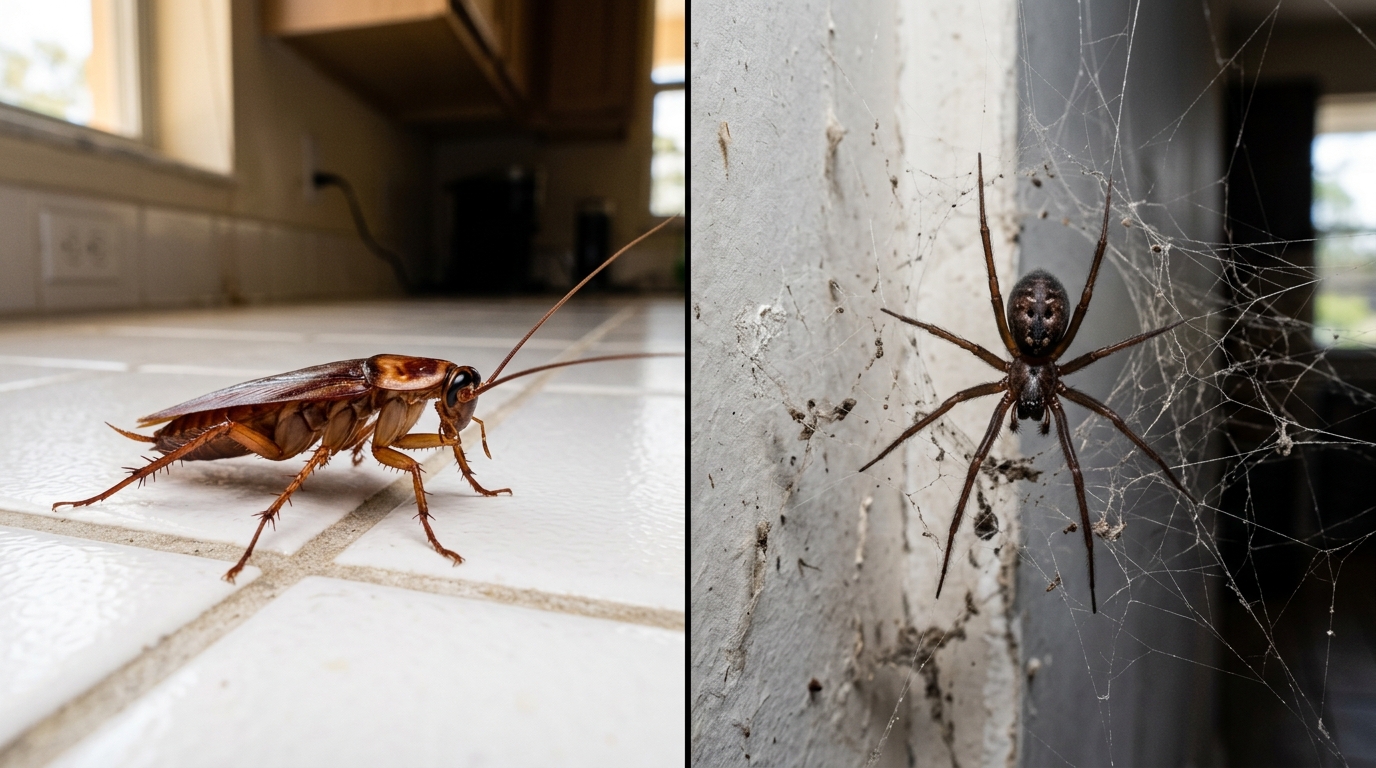
Who this guide is for and the decision you are actually making
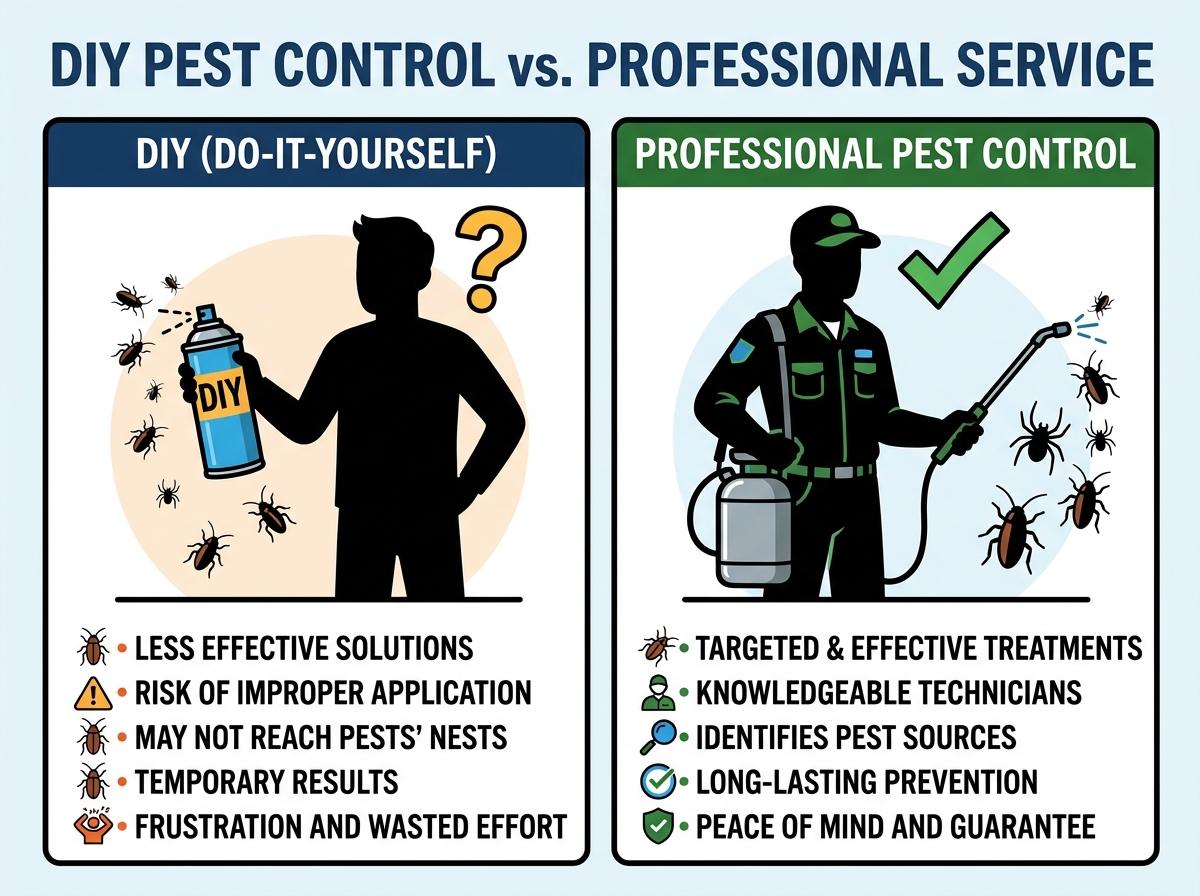
This guide is for a Florida homeowner facing two pests at once: cockroaches indoors and spiders around the perimeter. You want a licensed professional, not another can of spray. You are deciding who to call, what it should cost, and how soon someone can treat the property.
Callers open with the same three facts a scheduler needs: a short description of the pest problem, the ZIP code, and the property type. When a matching service or provider answers, expect questions like "What pest issue are you experiencing?", "What is your ZIP code?", and "Is it a single-family home, duplex, or apartment?" Those are not filler. They route your request to a provider who can legally and practically reach your address. You may also hear "How were you connected with us today?" or "Do you already have an active account with us?" — routing questions, not obstacles.
The order that saves you time
Work the decision in this sequence:
- Coverage first. Confirm a provider services your ZIP code before you discuss price.
- Pest fit second. Confirm one plan treats both roaches and spiders.
- Quote third. Only then compare cost, frequency, and scheduling.
HomePest Match is an independent information and provider-matching site. We are not a pest-control company and we do not treat homes. We help you describe the problem clearly and reach licensed local providers. You always initiate contact; nobody is dispatched without your request. When you call a provider, that call may be recorded for quality assurance, which is standard in the industry.
Getting the order right prevents the most common dead end: spending ten minutes describing a problem to a company that cannot service your street.
The gap most homeowners miss: your ZIP code may have no provider coverage
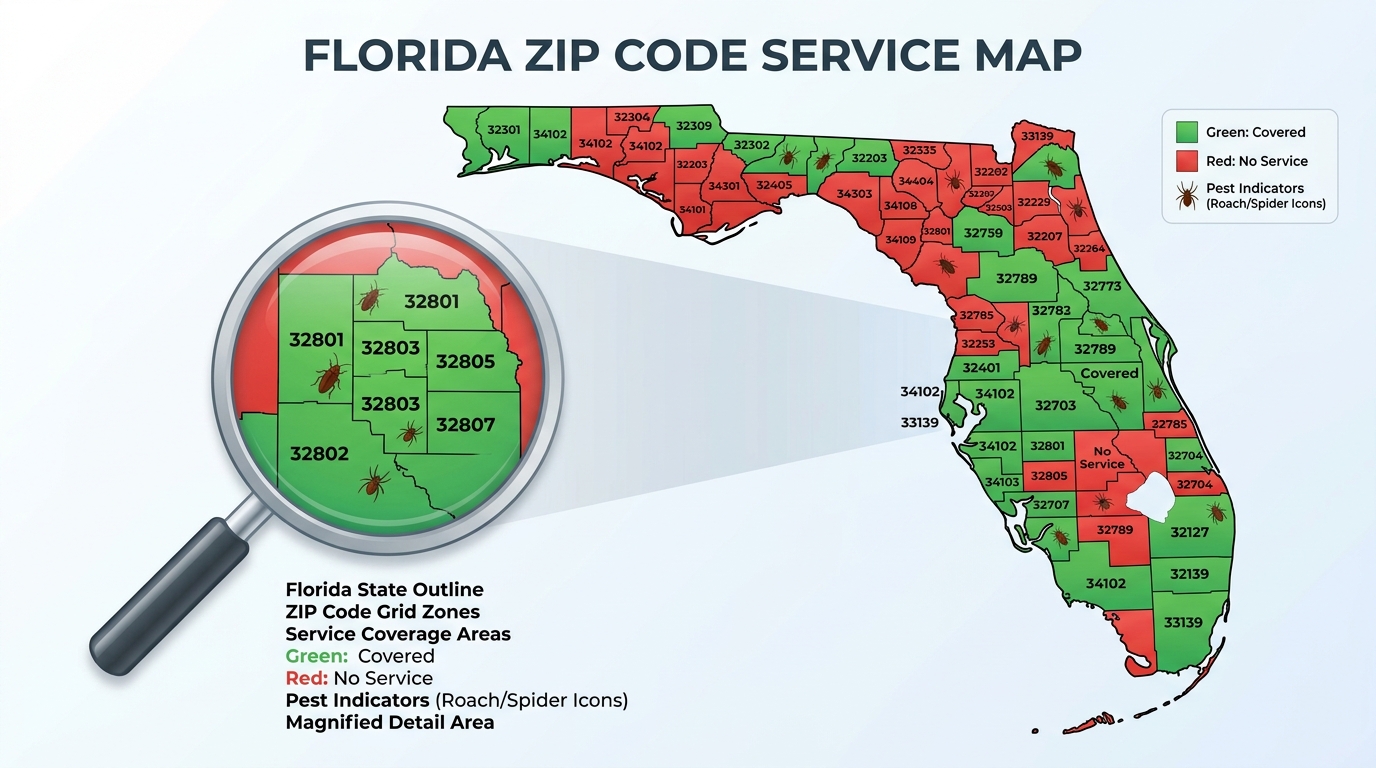
Here is the misunderstanding that derails good calls. Homeowners assume a company with a Florida presence, a national brand, or a nearby office automatically serves their address. It does not work that way. Coverage is granted ZIP code by ZIP code, sometimes street by street, based on route density, technician availability, and licensing.
Why a company can "be in Florida" and still not reach you
Pest-control routes are built around efficiency. A provider schedules technicians along clusters of nearby homes. If your address sits outside a serviced cluster, the branch may decline the job even though it advertises statewide. Rural and semi-rural addresses feel this most. When a scheduler asks "What city are you in?" and repeats your street back to confirm it, they are checking the route boundary, not being nosy.
This is why callers get transferred. One company says it cannot help, then routes the request to another that can. That hand-off is normal, and it is why coverage should be verified before anything else. If you are told "we don't cover that area," ask to be sent to a provider who does — you keep the initiative.
How to confirm coverage in one step
- Have your full property address and ZIP code ready before you call. "Three three six one two" is faster to service than a vague neighborhood name.
- State the ZIP first, then the street. Providers match on ZIP, then verify the specific address.
- Ask plainly: "Do you service this ZIP code and this street?" Get a yes before discussing plans.
Our companion page, Pest Control Service Area Coverage by ZIP Code, walks through the ZIP-check step in detail. If a provider cannot reach your address, the fix is not persuasion; it is finding a different licensed provider whose route includes you. Confirming coverage first turns a frustrating call into a short booking.
Reading the signs: telling a real infestation from a stray pest
Two pests, two very different biologies. Knowing what you have helps a provider quote accurately and helps you judge urgency. Callers often report roaches "in the cabinet, in the drawers, behind the stove" and bugs "coming through the window" from ill-fitting screens. Both details matter — they point to harborage and entry pressure.
Cockroach signs
The most common indoor invader in Florida homes is the German cockroach (Blattella germanica), a small, tan roach with two dark stripes behind the head. It breeds indoors and multiplies fast. Watch for:
- Live roaches in daylight — a sign the population is large enough that hiding spots are full.
- Oothecae — tan, purse-shaped egg cases, each holding roughly 30 to 40 eggs, often glued inside cabinet hinges and drawer runners.
- Fecal spotting — pepper-like specks near warm, moist harborage such as behind the refrigerator or under the sink.
- A musty, oily odor in heavy infestations.
The larger, reddish-brown American cockroach is a different problem. It lives mostly in drains, sewers, and moist exterior voids, and wanders in. It rarely breeds indoors in large numbers. A poorly seated window screen, as many callers describe, lets these outdoor wanderers through.
Spider signs
Most Florida house spiders are nuisance, not danger. Webbing in corners, garages, eaves, and around exterior lights usually signals abundant prey insects, not a spider crisis. Spiders follow food. A rising spider count often means gnats, flies, or roaches are feeding them.
Two groups deserve caution: the brown recluse (uncommon in Florida) and the widow spiders (black and brown widows, both established). Widows favor undisturbed voids — meter boxes, woodpiles, and garage corners. If you see a spider with a red hourglass marking, keep distance and mention it when you request service. For deeper species detail, see Spider Control in Florida and Cockroach Control in Florida.
What actually works — and where DIY fails
DIY controls the visible few. A professional program controls the breeding population and the entry pressure. Understanding the mechanisms tells you when to stop spraying and call.
Roaches: bait beats spray
Gel bait is the professional backbone against German cockroaches. Roaches feed on the bait, return to harborage, and die there; other roaches consume the contaminated feces and carcasses, spreading the active ingredient through the colony. This secondary kill, called horizontal transfer, is why bait outperforms contact spray. Technicians place small dots at hinges, drawer edges, and voids — the exact seams roaches travel.
Professionals also use insect growth regulators (IGRs), compounds that disrupt insect development. One example, hydroprene (sold as Gentrol), mimics juvenile hormone and prevents nymphs from reaching reproductive maturity. Others act as chitin-synthesis inhibitors, blocking the formation of a new exoskeleton at the molt, so the insect fails to shed and dies. IGRs do not kill on contact; they collapse the next generation, which is why results build over weeks. The U.S. Environmental Protection Agency (EPA) registers these products and sets their approved uses; you can look up a product in the EPA Pesticide Product Label System.
Why DIY roach control stalls
- Over-the-counter foggers scatter roaches deeper into voids without reaching harborage.
- Spraying over bait repels roaches from the bait — a common self-inflicted failure.
- Bait aversion: some German cockroach strains avoid glucose-based baits, so professionals rotate active ingredients.
Spiders: fix the food supply
Professionals de-web, treat cracks and eaves, and reduce the insect prey base — the durable fix, since killing spiders without cutting their food only invites more. This root-cause approach, combining inspection, sanitation, exclusion, and targeted product use, is called Integrated Pest Management (IPM). University extension services such as the University of Florida IFAS promote IPM over blanket spraying because it lasts longer and uses less product.
What to ask when you request quotes
A good quote conversation is short because you steer it. Ask these questions in order and you compare providers on the same terms. Callers often just say "I'm looking for a pest control quote" or "I want to make an appointment" — these questions turn that opener into a clear, bookable request.
Coverage and pest fit
- "Do you service my ZIP code and street?" Confirm this before anything else.
- "Does one plan cover both roaches and spiders?" Many general-pest plans do; confirm it in writing.
- "Is there anything else you treat under this plan?" Schedulers often ask you the reverse — "Is there anything else you see a lot?" — because ants, silverfish, or occasional invaders may already be included.
Program structure
- Initial versus recurring: German roach jobs usually need an intensive initial treatment plus follow-ups two to four weeks apart to break the egg cycle. Ask how many visits the quote includes.
- Frequency options: monthly, bimonthly, or quarterly. Florida's climate keeps pest pressure high year-round, so quarterly-only plans may struggle against active German roach populations.
- Re-service terms: ask whether follow-up visits between scheduled services are included if pests persist. Note that many providers avoid one-time-only jobs because they cannot stand behind lasting results without recurring visits.
Licensing and safety
- "Are your technicians licensed in Florida?" Structural pest control is regulated by the Florida Department of Agriculture and Consumer Services (FDACS), where you can verify a company's license.
- "What products will you use, and are they EPA-registered?" A professional can name the active ingredients.
- "Any prep or re-entry time after treatment?" Gel baits usually need little prep; ask about pets and children.
For a full checklist, see How to Choose a Pest-Control Company in Florida and, when you are ready, Request Florida Pest-Control Quotes.
Local notes for Florida homeowners
Florida's warmth and humidity shape both pests and treatment. Understanding the local pressure helps you set realistic expectations.
Year-round breeding
Unlike colder states, Florida rarely gets a hard winter freeze to knock back populations. German cockroaches breed indoors continuously, and outdoor spiders stay active most of the year. That is why many Florida providers favor recurring plans over one-time visits — sustained pressure needs sustained control. A caller who has "been dealing with this three or four years" is usually fighting a breeding population that never got a full-cycle treatment.
Moisture and harborage
Florida's humidity feeds pests. American cockroaches thrive in wet exterior voids, storm drains, and irrigation boxes, then migrate indoors during heavy rain. Reducing moisture — fixing leaks, improving drainage, clearing plant debris against the foundation — cuts both roach and spider pressure. Exterior lights draw the flying insects that spiders eat; switching to yellow "bug" bulbs or motion lighting reduces the buffet. Reseating a loose window screen closes a common entry point callers describe.
Coverage clusters by metro
Provider routes concentrate around Florida's population centers. If you live in or near a major metro, coverage is usually dense. Outlying and rural ZIP codes may have fewer providers per route, so confirming service before booking matters even more. City-specific pages can point you to local options:
- Pest Control in Jacksonville, FL
- Pest Control in Orlando, FL
- Pest Control in Tampa, FL
- Pest Control in Miami, FL
For statewide context on pests, seasons, and options, the Florida pest control guide gives the broader picture. Wherever you are, the coverage-first rule holds: a provider must service your exact ZIP and street before any plan can start.
Cost factors: what shapes a roach-and-spider quote
We do not publish fixed prices, because honest quotes depend on your specific home. Instead, know the factors that move the number so no quote surprises you.
What raises or lowers the price
- Infestation severity: a heavy German roach population needs a more intensive initial visit and more follow-ups, which costs more than a light spider perimeter treatment.
- Home size and layout: square footage, number of stories, and linear feet of foundation drive labor and product volume. Schedulers ask "What is your address?" partly to size the property.
- Property type: single-family homes, duplexes, and apartments differ in access and shared walls, which affects strategy and price.
- Service frequency: quarterly plans usually carry a lower per-visit-equivalent cost than monthly, but they may not visit often enough to break an active roach egg cycle.
- Initial versus ongoing: the first intensive treatment often costs more than recurring visits, which maintain control.
- Access and clutter: cluttered kitchens and blocked voids slow treatment and can require repeat visits.
Frequency trade-offs in plain terms
Think of frequency as a timing question, not just a price question. A German cockroach ootheca hatches roughly every three to four weeks, and IGRs act on nymphs across that window. A monthly or two-to-four-week follow-up schedule lines visits up with that hatch cycle, so each treatment catches the newly emerged generation. A quarterly-only plan may be published at a lower per-visit rate, but with visits 90 days apart, two or three hatches can occur between them — so an active roach population can rebound between services, and the cheaper plan can cost more over the full season. For a light spider perimeter with no breeding indoors, quarterly is often reasonable. Match the frequency to the biology, not to the sticker.
How to compare fairly
Get quotes from more than one licensed provider, and make sure each quote covers the same scope: both pests, the same number of initial and follow-up visits, and the same re-service terms. For a deeper breakdown of pricing structure, read Pest Control Cost in Florida and How to Get a Pest Control Quote in Florida. When you understand the factors, you can judge whether a number is fair for your home — and confirm, first and always, that the provider actually covers your ZIP code.
Common questions
What if no provider covers my rural address?
Coverage is set ZIP by ZIP, so a rural address may fall outside a route. If one provider declines, ask to be routed to another licensed company, or search a nearby metro's providers who extend into your area. You always initiate the contact, so keep calling until you reach one whose route includes your street.
How do I check whether a company covers my ZIP code?
Have your full address and ZIP ready, state the ZIP first, then confirm the street. Ask directly whether they service that exact ZIP and street before discussing any plan. Our ZIP coverage guide walks through the check step by step.
Can one plan treat both roaches and spiders?
Usually yes. Most general-pest plans in Florida cover common roaches, spiders, ants, and similar occasional invaders. Confirm both pests are included in writing, and ask what else the plan covers, since many programs treat more than you expect.
Why does a professional beat store-bought sprays for German roaches?
Professionals use gel bait and insect growth regulators that work through the colony rather than just killing what you see. Bait spreads through feeding and shared harborage, and IGRs like hydroprene stop nymphs from maturing. Store sprays often scatter roaches deeper and can repel them from bait.
How do I verify a Florida provider's license and local coverage?
Structural pest control is regulated by the Florida Department of Agriculture and Consumer Services (FDACS), where you can verify a company's license. For coverage, confirm your specific ZIP and street with the provider directly, since a statewide brand does not guarantee service to every address.
Is HomePest Match a pest control company?
No. HomePest Match is an independent information and provider-matching site operated by EmberPath Media LLC. We do not treat homes or dispatch technicians. We help you describe your problem and reach licensed local providers, and you always initiate contact.
Related: Pest Control Service Area Coverage by ZIP Code · Cockroach Control in Florida · Spider Control in Florida · How to Choose a Pest-Control Company in Florida · Request Florida Pest-Control Quotes