Red Ants Inside the Basement: Identify Them and Confirm Service for Your Address
Red ants in a basement almost always point to moisture, a hidden nest, or a foraging trail from outside. Before you book any treatment, the first thing to settle is whether a provider covers your address. This guide shows how to check coverage by ZIP code, then explains what actually removes the ants.
Calls may be recorded for quality and matching purposes.
Who this guide is for and what you are deciding
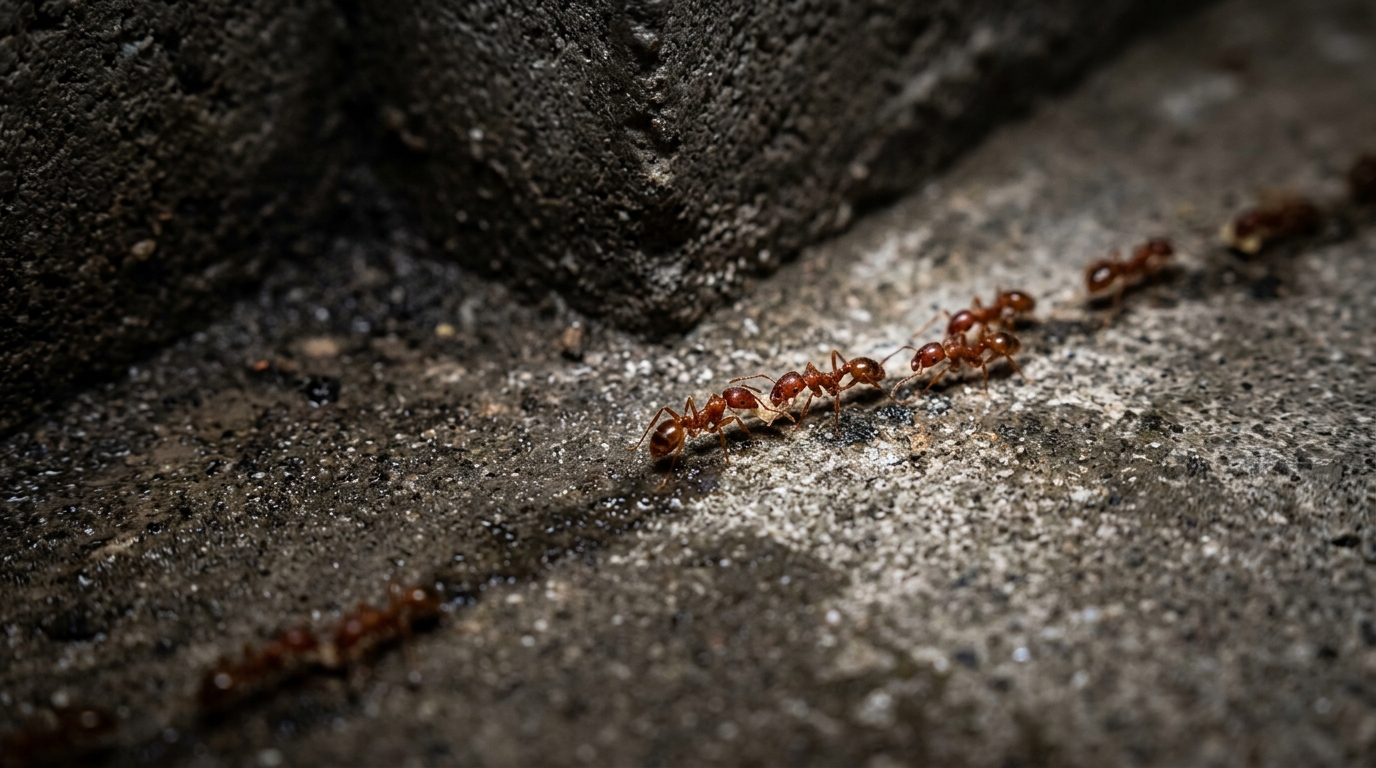
You found small reddish ants marching across a basement floor, along a sill plate, or near a floor drain. You want them gone, and you want a price. But two questions sit in front of the price: does a licensed provider serve your address, and is your problem the kind that needs a professional? This guide answers both.
HomePest Match is an independent information and matching site. We are not a pest-control company, and we do not treat homes. We help homeowners describe the problem clearly, check whether coverage exists for their ZIP code, and prepare for a useful quote conversation. When you contact a provider, you start the call; providers do not cold-call you.
Here is the decision path most homeowners actually follow:
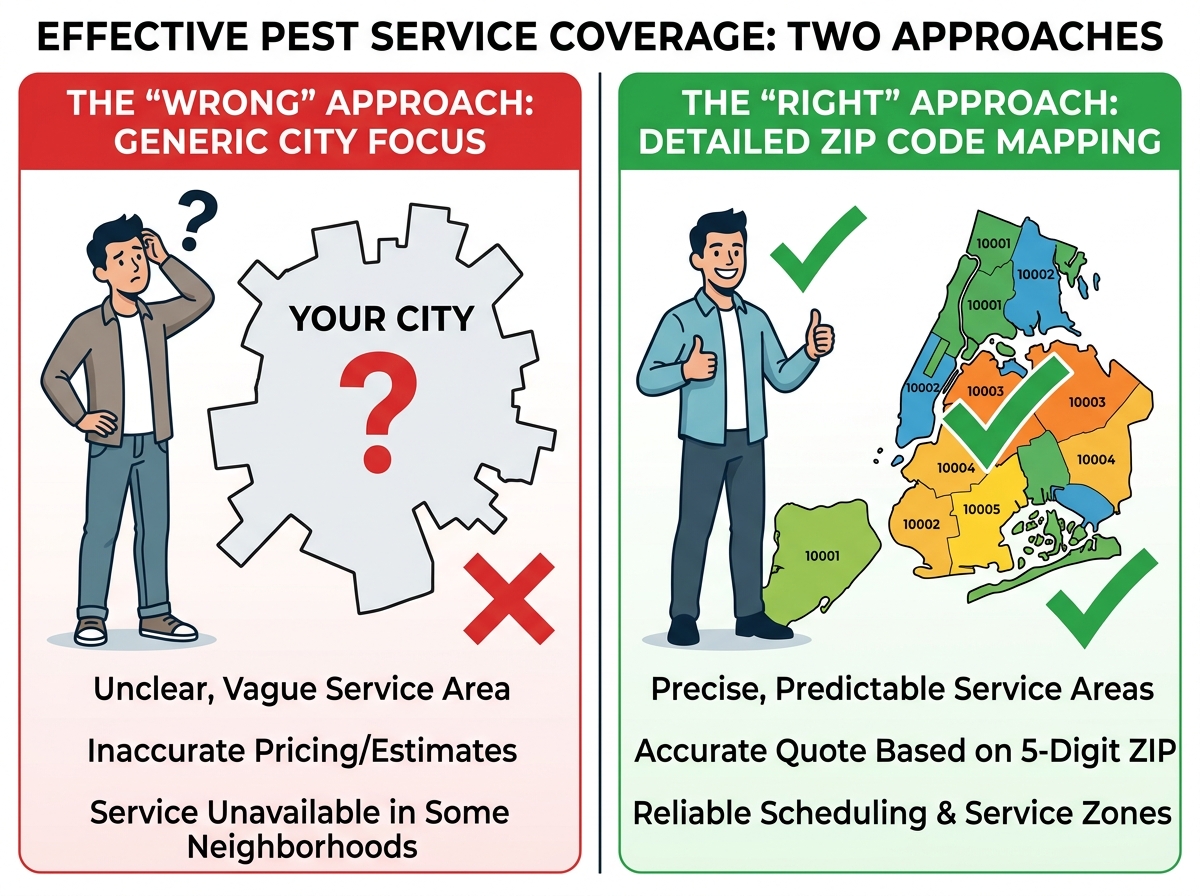
- Confirm the address qualifies. Coverage is set by ZIP code and service radius, not by city name alone. A provider may cover part of a metro and skip rural fringes.
- Identify the ant. Reddish ants in a basement are usually pavement ants, odorous house ants, or occasionally carpenter ants — rarely true fire ants indoors in cooler regions.
- Decide DIY versus professional. A single foraging trail may respond to bait. A structural nest, or ants tied to a moisture leak, usually needs a trained technician.
- Request a quote with the right details. Address, ZIP, pest, and where you see them shape the estimate.
When you call a provider, expect basic intake questions: your name, spelling of your name, your street address, and your city — the same questions in the real caller language below. Calls may be recorded for quality and training. That is standard, and disclosure is provided at the start of most provider calls.
The part homeowners get wrong: coverage depends on your ZIP, not your city
The most common misunderstanding is assuming that if a provider "serves the area," it serves your exact home. Coverage is drawn by ZIP code and service radius, and it changes at the edges. Two homes on the same road can fall on opposite sides of a coverage line.
Why the address, not the city, decides
In real intake calls, the technician asks for the street address first, then the city, then confirms the road name. That order is deliberate. The city tells them the general market; the street address and ZIP tell them whether a route and a licensed technician actually reach you. A provider may cover a city center yet decline addresses beyond a set drive time.
How to check coverage before you spend time on a quote
- Find your ZIP code. Use the ZIP that matches your mailing address, not a nearby town's ZIP.
- Match ZIP to pest fit. Confirm the provider treats your pest — ants in this case — under a general pest plan.
- Then request the estimate. Only after ZIP and pest fit are confirmed does a price mean anything.
Think of it as a three-step flow: ZIP check → pest fit → estimate. Skipping to price wastes your time if the address never qualified.
What if no provider covers a rural address
Rural and edge-of-metro addresses sometimes fall outside every nearby provider's radius. If that happens, options include asking whether the provider offers a limited-visit plan at a travel surcharge, contacting a provider based in the next town over, or handling a small foraging problem yourself with baits while you keep searching. Our companion page on service-area coverage by ZIP code walks through this in detail.
To verify a national franchise really services your street, ask for the local branch address and the technician's state license number, then confirm that license with your state's structural pest-control regulator. Coverage claimed on a website is not the same as a truck that shows up.
How to recognize red ants and read the warning signs
"Red ants" is a description, not a species. Correct identification changes the treatment. Look at size, color pattern, and where the ants travel.
The likely suspects indoors
- Pavement ants — about 2.5 to 4 mm, dark brown to reddish, with faint grooves on the head and thorax. They nest under slabs and along foundation cracks and follow trails to food.
- Odorous house ants — dark, roughly 2 to 3 mm, and they give off a coconut-like smell when crushed. They favor moist areas and can appear reddish under light.
- Reddish carpenter ants — larger, 6 to 13 mm, often bicolored with a reddish thorax. They tunnel into damp or decayed wood. Their presence signals a moisture problem and possible wood damage.
- Fire ants — reddish and stinging, but they nest outdoors and rarely establish indoor colonies in cool-climate basements.
Signs the problem is real, not a stray scout
A lone ant is a scout. These signs mean an established presence:
- A persistent trail that returns within hours after you wipe it away — ants follow pheromone paths.
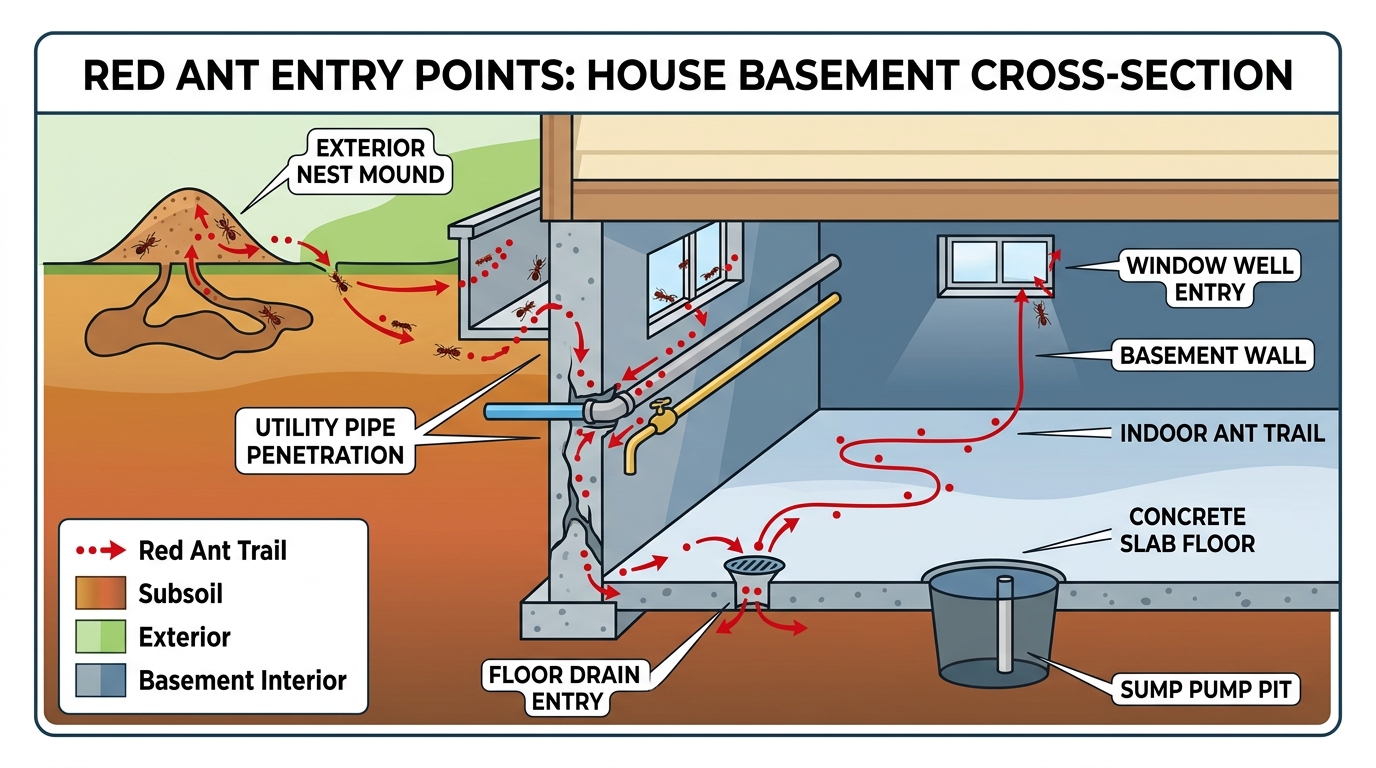
- Ants concentrated near moisture: a sump pit, a leaking pipe, a floor drain, or damp foundation wall.
- Frass — sawdust-like shavings — near baseboards or wood framing, which points to carpenter ants.
- Winged ants (alates) at a basement window in spring, which suggests a mature colony swarming.
Note whether the ants come from a wall crack, a utility penetration, or the sill plate. Providers ask exactly where you see them because entry point and nest location drive the treatment strategy. When you describe the problem, saying "reddish ants trailing from the sill plate near the sump" is far more useful than "bugs in the basement."
What actually works — and when DIY fails
Effective ant control follows Integrated Pest Management (IPM), an approach promoted by university extension services that combines inspection, sanitation, exclusion, and targeted product use rather than blanket spraying.
The methods that remove a colony
- Slow-acting gel and granular baits. Foragers carry bait back to the nest and feed the queen and brood. Baiting works because it kills the colony, not just the ants you see. Speed is intentionally slow so workers survive long enough to share it.
- Non-repellent liquid products. Ants cannot detect these, so they walk through and transfer the active ingredient by contact — a mechanism that reaches hidden nests. Products sold for structural ant control are registered by the U.S. Environmental Protection Agency, which reviews their labels for safety and use sites.
- Growth regulators. Some professional formulations include insect growth regulators that disrupt development, so the colony cannot replace lost workers.
- Exclusion and moisture correction. Sealing sill-plate gaps, foundation cracks, and utility penetrations with appropriate sealant removes entry routes. Fixing the leak or drying the sump area removes the reason ants chose your basement.
Why DIY fails
DIY works for a small, correctly identified foraging trail. It fails predictably when:
- You spray a repellent over a bait. Repellent sprays scatter the colony into satellite nests — a phenomenon called budding — and make the problem worse.
- The species is wrong. A bait matched to sugar-feeders fails on a protein-feeding colony, and vice versa.
- Carpenter ants are involved. These require finding the moisture-damaged wood and the parent nest, which may sit outside in a tree or fence and travel indoors along wiring.
- Moisture is never fixed. Ants return to the same conditions no matter how many you kill.
A professional adds identification, non-repellent access to hidden nests, and follow-up. For a broader comparison of methods and timelines, see the ant control guide.
What to ask when you request a quote
A quote is only as good as the information behind it. Before you commit, confirm the fit and the terms. Bring these questions to the call.
Confirm the address and the pest first
- "Do you cover my ZIP code and this street address?" Give the exact ZIP, not just the city.
- "Does your general pest plan include ants in a basement?" Some plans exclude carpenter ants or treat them as a separate structural service.
- "Are you licensed in this state, and can I have the license number?" You can verify structural pest-control licenses with your state regulator.
Understand the treatment and the terms
- "Will you identify the species before treating?" Identification should come first.
- "Do you use baits, non-repellent liquids, or both, and why for my situation?"
- "Is this a one-time service or a recurring plan, and what does each visit include?"
- "What re-treatment or plan terms apply if ants return within the plan period?" Ask how their treatment plan handles recurrence — never expect a promise of specific results.
- "Do you address moisture and exclusion, or only spray?" Spray-only visits rarely solve a basement ant problem tied to water.
What the intake will sound like
Expect the provider to ask for your first and last name, the spelling of your name, your street address, your city, and what else you see besides ants. If you also notice spiders or the occasional roach, say so — a combined plan is common and shapes the quote. To prepare a clear report, read how to report a pest problem and what to expect when you report a pest issue. Clear detail on the first call means a tighter, more accurate estimate.
What shapes the price of a basement ant treatment
No honest guide can quote a flat number sight unseen, and we will not invent one. Instead, here are the concrete factors that move a basement ant estimate up or down. Understanding them lets you read a quote critically.
Factors that raise the price
- Species complexity. Carpenter ants cost more than pavement or odorous house ants because they require locating a parent nest and inspecting for wood damage.
- Nest location. A colony inside a wall void or under a slab needs drilling or specialized non-repellent application, which adds labor.
- Moisture remediation. If the ants follow a leak or a damp sump, fixing the conditions — often coordinated with the homeowner — adds scope.
- Home size and access. Larger footprints, finished basements, and tight crawl spaces increase inspection and treatment time.
- Service radius. Addresses at the far edge of a provider's coverage can carry a travel component.
Factors that lower the effective cost
- Early action. A single foraging trail caught early is cheaper than a mature, budded colony.
- Recurring plans. Quarterly or monthly plans usually cost less per visit than one-off calls and often bundle ants with spiders and other common pests.
- Bundled pests. If you report ants plus spiders or roaches together, one plan may cover all three rather than separate services.
How pricing is usually structured
Providers commonly offer a one-time treatment, an initial service plus recurring maintenance, or a full annual plan. Published homeowner ranges vary widely by region, species, and home size, so treat any number you see online as a starting point, not a promise. For how plans and visits are structured, see pest-control service plans and pricing. The reliable move is to confirm coverage for your ZIP, describe the ants precisely, and compare two or three itemized quotes.
Common questions
How do I know if my address qualifies for pest-control service?
Coverage is set by ZIP code and service radius, not by city name. Give a provider your exact ZIP and street address, and ask directly whether they service it. Two homes on one road can fall on opposite sides of a coverage line.
What if no provider covers my rural address?
Ask nearby providers whether they offer a limited-visit plan with a travel surcharge, or contact a provider based in the next town. For a small foraging trail, targeted baits can hold the problem while you keep searching. Our ZIP-coverage guide covers edge cases in detail.
How do I verify a franchise really covers my street?
Ask for the local branch address and the technician's state license number, then confirm that license with your state's structural pest-control regulator. A coverage claim on a website is not the same as a licensed truck reaching your home.
Are the red ants in my basement fire ants?
Usually no. Reddish indoor ants in a basement are far more often pavement ants, odorous house ants, or carpenter ants. True fire ants nest outdoors and rarely establish indoor colonies in cooler regions. Exact identification changes the treatment.
Can I just use store-bought spray?
For a small, correctly identified trail, baits can work. Repellent sprays often backfire — they scatter the colony into satellite nests, a process called budding, and make the problem worse. Carpenter ants and moisture-driven infestations usually need a professional.
Do providers call me back, or do I contact them?
You initiate contact with a provider. Expect intake questions about your name, its spelling, your street address, your city, and any other pests you see. Calls may be recorded for quality, and that disclosure is typically stated at the start.
Related: pest control service area coverage by ZIP code · ant control guide · how to report a pest problem · pest-control service plans and pricing · what to expect when you report a pest issue